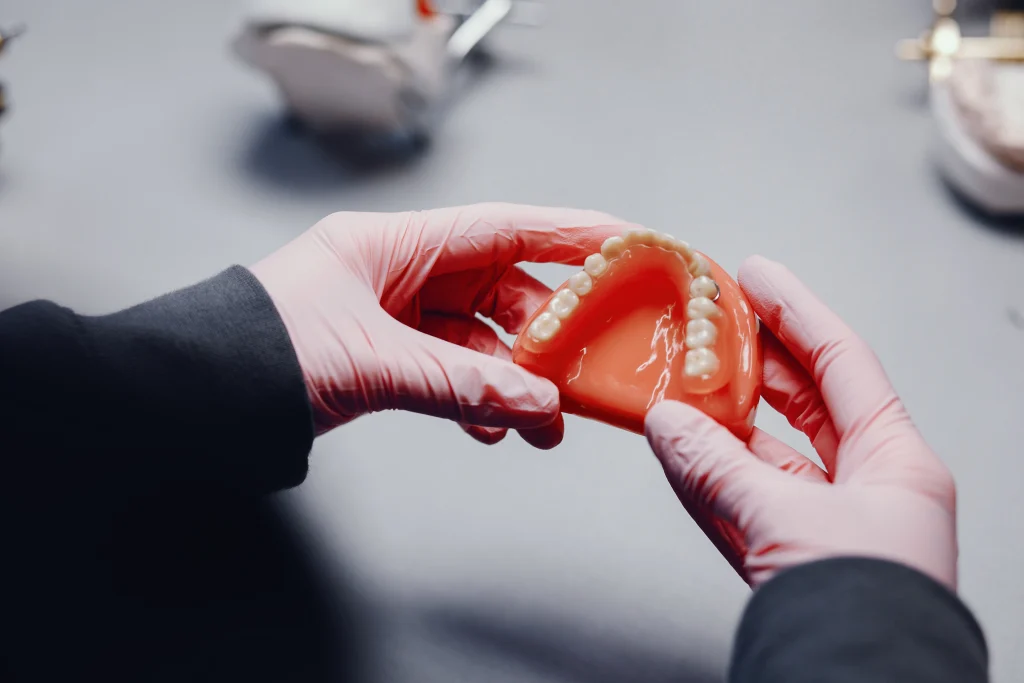
A cast partial denture is a removable prosthesis built on a cast metal framework, usually cobalt-chromium, that replaces several missing teeth while drawing support from the remaining teeth and ridge. This guide covers its parts, how it compares with acrylic and flexible partials, how it is made, and how to select cases, so you can decide when to prescribe one and what to specify to your lab.
What is a cast partial denture?
A cast partial denture is a removable partial denture whose rigid framework is cast in metal, most often cobalt-chromium alloy, and which carries acrylic denture bases and artificial teeth to replace missing teeth in a partially edentulous arch.
The framework is cast from a wax pattern made on a master cast, so it can be fitted accurately to surveyed abutments. Occlusal rests direct chewing load down the long axis of the abutment teeth instead of leaving it all on the soft tissue, which is the main design difference from an all-acrylic partial. Cobalt-chromium is stiff enough to allow thin connectors, which helps tongue comfort and speech.
The Kennedy classification groups arches by the position of the edentulous spaces and guides the design. Class I is bilateral distal extension, Class II is unilateral distal extension, Class III is a unilateral bounded space and Class IV is a single anterior span crossing the midline. Distal-extension arches need extra attention to tissue support because the base moves under load.
Parts of a cast partial denture
A cast partial denture has five core components: the major connector, minor connectors, rests, direct retainers (clasps) and the denture base that carries the artificial teeth.
- Major connector: the rigid bar or plate (such as a lingual bar, lingual plate or palatal strap) that joins the components across the arch.
- Minor connectors: the small struts that link the major connector to rests, clasps and bases.
- Occlusal rests: metal extensions seated in prepared rest seats that transmit load to the abutments and keep the framework in position.
- Direct retainers (clasps): arms, such as the circumferential Akers clasp or the RPI system for distal extensions, that engage undercuts to resist displacement.
- Denture base and teeth: acrylic over the retention meshwork that replaces the missing teeth and covers the edentulous ridge.
Design starts on the surveyor, where the path of insertion, guide planes and undercuts are set. Precision attachments can replace visible clasps in esthetic cases, but they usually require crowned abutments. When abutments need zirconia crowns or metal crowns, planning rest seats, guide planes and contours with the framework in mind helps avoid remakes.
Key differences: cast partial vs acrylic partial vs flexible partial
A cast partial denture is rigid and tooth-supported, an acrylic partial is the lowest-cost, mainly tissue-supported option, and a flexible partial is a thermoplastic, clasp-free option chosen mainly for esthetics.
| Feature | Cast partial (cobalt-chromium) | Acrylic partial | Flexible partial |
|---|---|---|---|
| Framework | Cast metal framework | No framework; acrylic base with wire clasps | Thermoplastic resin, no metal framework |
| Support | Tooth and tissue, via rests | Mainly tissue | Mainly tissue |
| Rigidity and bulk | Rigid, thin connectors | Bulkier base | Flexible, thicker sections |
| Retention | Clasps or attachments; predictable | Wire clasps; less stable | Resin clasps; can loosen over time |
| Esthetics | Metal clasps may show unless designed around | Wire clasps may show | Tooth-colored clasps |
| Adjustment and relining | Clasps adjustable; relinable | Easy to reline and repair | Limited adjustment and relining |
| Typical role | Definitive, long-term prosthesis | Interim or budget prosthesis | Selected esthetic cases |
| Cost | Higher | Lowest | Moderate to high |
The main trade-off is rigidity against appearance. Cast frameworks give the best load distribution and the most predictable retention, while flexible partials look less conspicuous but give up rigidity and easy modification. Acrylic partials remain useful as transitional or budget solutions, though they place more load on the tissue and the abutments.
A 2017 randomized study of 50 patients with Kennedy Class I and II arches (25 per group) compared cast and acrylic partials over one year. The cast group kept retention and stability better at 12 months, while masticatory efficiency and abutment periodontal health declined in the acrylic group. The authors noted this held with adequate oral and denture hygiene (Suwal et al., 2017). It is a small, single-centre study, so read it as supportive evidence rather than a final answer.
Benefits and limitations of a cast partial denture
The main benefit of a cast partial denture is stable, tooth-supported function in a thin, rigid, repairable prosthesis; its main limitations are cost, visible clasps in some designs and dependence on sound abutments.
Benefits:
- Rigid framework that allows thin connectors and good load distribution.
- Rest-based tooth support, which limits movement and tissue loading.
- Predictable retention, with clasps that can be adjusted over time.
- Can be relined and repaired as the ridge remodels.
Limitations:
- Higher cost and more clinical and laboratory steps than an acrylic partial.
- Metal clasps can be visible in the anterior or premolar region.
- Needs periodontally sound abutments and careful mouth preparation.
- Poor hygiene raises plaque retention around clasps and abutments.
- Patients need time to adapt to a removable prosthesis. Check alloy composition if metal hypersensitivity is reported.
How is a cast partial denture made and fitted?
A cast partial denture is made in sequence: diagnosis and impressions, surveying and design, mouth preparation, master impression, framework casting and try-in, teeth set-up, delivery and review.
- Examination and diagnosis: take histories, assess periodontal and caries status, take radiographs and diagnostic casts, and classify the arch.
- Surveying and design: survey the cast, set the path of insertion and mark connectors, rests and clasps in the lab prescription.
- Mouth preparation: complete periodontal and restorative care, prepare rest seats and guide planes, and finish any abutment crowns.
- Master impression: record abutments, ridges and soft tissue; in distal-extension cases, consider a technique that records functional tissue support.
- Framework fabrication: the lab builds the wax pattern to your design, casts the cobalt-chromium, then finishes and polishes it.
- Framework try-in: check seating, rest fit, clasp passivity and occlusal clearance, then record the jaw relation.
- Teeth set-up: verify esthetics, occlusion and vertical dimension at the wax try-in.
- Delivery: adjust occlusion and retention, and give hygiene instructions.
- Review: recall after the first days, then at regular intervals; reline when the base no longer fits the ridge.
Which option is right for you? Case selection checklist
A cast partial denture is usually the right choice for multiple missing teeth or distal-extension spaces when the abutments are sound, the patient can keep the prosthesis clean, and a long-term removable solution is acceptable.
- Number and position of missing teeth: Kennedy Class I and II arches, long spans and multiple spaces favor a cast design.
- Abutment health: stable periodontal support, a favorable crown-root ratio and enough tooth structure for rests.
- Bone and ridge support: adequate ridge form helps retention and stability; severe resorption needs careful base design.
- Budget: if cost is the main constraint, an acrylic partial may serve as an interim step.
- Esthetic demands: high smile line or strong objection to metal may point to attachments or a flexible partial.
- Medical considerations: manual dexterity, hygiene ability, high caries risk, dry mouth and reported metal sensitivity.
Consider a fixed bridge when a short bounded span has strong abutments, or an implant-supported restoration when bone, health and budget allow. Choose a cast partial when those options are not suitable or not wanted. Yes Dental’s crown and bridge work can be coordinated with your framework case when abutments need restoration first.
Care, maintenance and how long a cast partial denture lasts
A well-made cast partial denture is commonly expected to last roughly 5 to 10 years or longer [verify], depending on hygiene, abutment health, ridge resorption and regular recall.
Share these points with patients: remove the denture after meals and rinse it; brush all surfaces gently with a soft brush and a non-abrasive cleanser; avoid hot water; clean the natural teeth under the clasps carefully; and leave the denture out at night as you advise. Book recall visits to check fit, clasp retention and abutment health. Relining and clasp adjustment extend service life, and a remake is usually needed when the framework no longer fits.
Frequently asked questions
What is a cast partial denture?
A cast partial denture is a removable prosthesis built on a cast metal framework, usually cobalt-chromium, that replaces several missing teeth. Rests, clasps and connectors transfer load to the remaining teeth and ridge, while acrylic bases and artificial teeth restore function and appearance.
How is a cast partial denture different from an acrylic partial denture?
A cast partial has a rigid metal framework supported by tooth rests, while an acrylic partial is a resin base with wire clasps that relies mainly on soft tissue. In a 2017 one-year comparison, the cast design kept retention and stability better than the acrylic design.
How long does a cast partial denture last?
With good hygiene and regular recall, a cast partial denture is commonly expected to last roughly 5 to 10 years or more. Longevity depends on abutment health, ridge resorption and clasp fatigue. Relining and clasp adjustment extend service life, and a remake is needed when the framework no longer fits.
Is a cast partial denture removable?
Yes. A cast partial denture is removable. Patients take it out for cleaning and overnight rest, and it seats on rests and clasps over the remaining teeth. It is not cemented or screwed in, unlike a fixed bridge, which only the clinician can remove.
Is a cast partial denture better than a flexible partial?
It depends on the case. A cast partial offers more rigidity, tooth support and adjustability, which suits long spans and distal-extension arches. A flexible partial can look more natural because it avoids metal clasps, but it is less rigid and harder to reline. Choose by span, abutment health and esthetic demand.
Who is a good candidate for a cast partial denture?
Good candidates have several missing teeth, especially distal-extension spaces (Kennedy Class I or II) or multiple spans, with periodontally sound abutments, adequate support and reasonable oral hygiene. Patients who cannot have a fixed bridge or implants, or prefer to avoid surgery, are also commonly considered.
How do you clean and care for a cast partial denture?
Remove it after meals, rinse, and brush all surfaces gently with a soft brush and a non-abrasive denture cleanser. Avoid hot water and abrasive pastes, clean the natural teeth under clasps carefully, leave the denture out at night as advised, and attend regular recall visits for fit and abutment checks.
How much does a cast partial denture cost in India?
Cost in India varies with alloy, design, number of teeth, attachments, laboratory and clinic, so no single figure applies. A cast partial usually costs more than an acrylic partial because of the framework’s materials and extra clinical and laboratory steps. Ask your lab for a written quote.
Conclusion
A cast partial denture remains a dependable, well-documented option for multiple missing teeth when abutments are sound and hygiene is maintained. Clear case selection and a precise lab prescription are what make it succeed. Contact the Yes Dental team to discuss your next case, and ask for the price list and case guidelines.