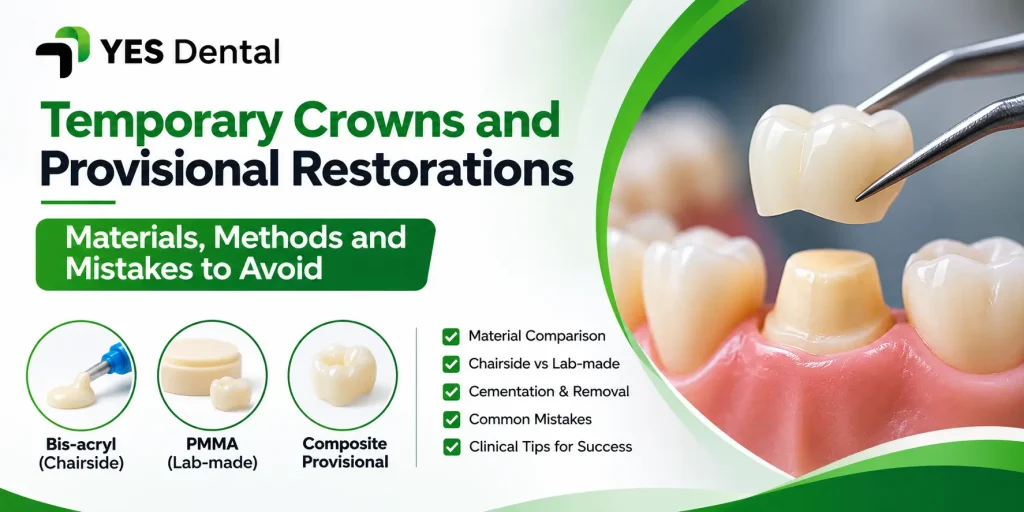
A temporary crown is more than a cover for a prepared tooth. A well-made provisional restoration protects the tooth, maintains its position, supports healthy gum tissue and gives the dentist an opportunity to assess the shape, bite and appearance before the final restoration is placed.
Choosing the right provisional material and technique depends on how long the restoration needs to remain in the mouth, the number of units involved and the clinical requirements of the case.
In this guide, we compare common temporary crown materials, explain chairside and laboratory-made methods, and discuss practical mistakes dentists should avoid.
Key Takeaways
- Provisional restorations protect prepared teeth and help maintain tooth position and soft-tissue contours.
- Bis-acryl is commonly used for short-term chairside provisionals.
- PMMA may be considered for longer-term and multi-unit provisional restorations.
- Marginal fit, occlusion, contacts and cementation all affect provisional performance.
- Photographs and feedback about an approved provisional can help guide the final restoration.
1. What Is a Provisional Restoration?
A provisional restoration is a temporary crown, bridge or veneer placed between tooth preparation and delivery of the definitive restoration.
The terms temporary, interim and provisional are often used interchangeably. However, a provisional restoration has a defined clinical purpose beyond covering a prepared tooth.
It may be used to protect the preparation, maintain tooth position, support soft tissue, assess aesthetics and evaluate the patient’s bite before the final restoration is completed.
2. Why Are Provisional Restorations Important?
A provisional restoration performs several functions during the treatment period.
| Function | Why It Matters |
|---|---|
| Protects the prepared tooth | Covers exposed dentine and helps reduce sensitivity |
| Maintains tooth position | Helps prevent unwanted drifting, tilting or over-eruption |
| Protects gum tissue | A well-contoured margin can support tissue health |
| Shapes soft tissue | Helps guide gum contours, particularly in aesthetic and implant cases |
| Tests aesthetics | Allows assessment of shape, length and appearance |
| Tests function | Helps evaluate bite, speech and chewing |
| Supports laboratory communication | Provides a reference for the intended final restoration |
An inadequately designed provisional may contribute to gum irritation, unwanted tooth movement, bite problems or difficulties during final restoration placement.
3. Temporary Crown Materials: Bis-acryl vs PMMA vs Composite
The choice of provisional material depends on the clinical situation, required duration, restoration design and manufacturer’s instructions.
| Feature | Bis-acryl | PMMA / Acrylic | Composite-based provisional |
|---|---|---|---|
| Common method | Chairside cartridge or syringe | Lab-made, heat-cured or milled | Layered, injected or light-cured |
| Typical use | Short-term single units | Longer-term and multi-unit cases | Selected aesthetic or interim cases |
| Strength | Suitable for many short-term cases; may fracture under heavy loading | Can be suitable for longer wear, depending on product and design | Varies by product and technique |
| Aesthetics | Good shade options | Can be polished and characterised | Can provide good aesthetic results |
| Repair and adjustment | Product and technique dependent | May require additional laboratory work | Often adjustable, depending on material |
| Important consideration | Follow setting and handling instructions | Check material indications and processing requirements | Follow curing and finishing instructions |
Material properties vary by manufacturer and product. Always follow the relevant instructions for use.
Bis-acryl provisional materials
Bis-acryl materials are commonly supplied in cartridges or syringes and used with a matrix or template. They are convenient for chairside fabrication, particularly for selected single-unit and short-term cases.
PMMA provisional materials
Polymethyl methacrylate (PMMA) can be used for laboratory-made or milled provisional restorations. It may be considered for longer-term wear, multiple units and more complex cases, depending on the product and design.
Composite-based provisional materials
Composite-based materials may be used for selected provisional restorations where their handling, strength and aesthetic properties suit the case. Their performance depends on the material and technique used.
4. Chairside vs Lab-Made Provisional Crowns
Dentists can choose between chairside and laboratory-made provisionals depending on the case.
| Factor | Chairside Provisional | Lab-Made Provisional |
|---|---|---|
| Fabrication | Made during the clinical appointment | Prepared by the dental laboratory |
| Time | Can be completed during the visit | Requires laboratory coordination |
| Cost | Often lower | May be higher |
| Fit and finish | Depends on clinical technique | Depends on records, design and laboratory process |
| Typical application | Selected single units and short-term cases | Multiple units, longer-term and complex cases |
| Planning | Often uses a matrix or template | May require a scan, impression or diagnostic wax-up |
Some clinicians use both approaches: a chairside provisional at the preparation appointment, followed by a laboratory-made provisional when the treatment requires a longer period or more complex design.
5. Short-Term vs Long-Term Provisional Restorations
The expected duration is an important factor when selecting a provisional material.
Short-term provisionals are generally used for a limited period, such as the days or weeks before the definitive restoration is ready. A suitable chairside material may be sufficient for many single-unit cases.
Long-term provisionals may be required during implant healing, tissue conditioning, occlusal changes or phased treatment. These cases need careful material and design selection.
For longer-term use, consider:
- A material suitable for the expected duration and loading.
- Adequate strength and restoration thickness.
- Smooth, well-polished surfaces that support hygiene.
- Appropriate occlusal contacts.
- Regular clinical reviews to assess wear, margins and tissue response.
The appropriate duration and material should be determined according to the clinical situation and product instructions.
6. Temporary Crown Cementation and Removal
A provisional restoration needs to remain secure during the treatment period but should also be removable without unnecessary damage to the preparation.
Important considerations include:
- Clean the preparation and manage moisture according to the cement manufacturer’s instructions.
- Select a temporary cement appropriate for the restoration and clinical situation.
- Avoid using excessive cement.
- Remove excess cement carefully around the margins and contacts.
- Check occlusion and adjust any high contacts.
- Provide the patient with clear care instructions.
Before placing the definitive restoration, remove the provisional carefully and clean the preparation thoroughly. Residual temporary cement may interfere with seating or the final cementation procedure.
The specific cementation and removal protocol should follow the product instructions and clinical requirements.
7. How Can a Provisional Help Guide the Final Crown?
A provisional restoration can act as a useful communication reference between the dentist and dental laboratory.
If the dentist and patient are satisfied with the provisional, relevant information can be shared to help guide the definitive restoration.
Consider providing:
- Front and side photographs of the provisional in the mouth.
- Notes about preferred length, contour and midline.
- A scan or model of the provisional, where available.
- Feedback about gum response and emergence profile.
- Any bite or occlusal changes made during the provisional stage.
This information gives the laboratory a clearer reference for the intended restoration instead of relying only on the preparation scan.
8. Common Temporary Crown Mistakes and How to Avoid Them
| Common Mistake | Possible Result | What to Check |
|---|---|---|
| Open or rough margins | Gum irritation and plaque accumulation | Trim, finish and check margins carefully |
| High occlusal contacts | Fracture, discomfort or sensitivity | Check and adjust the bite |
| Overly tight proximal contacts | Difficulty flossing and gum irritation | Adjust contacts appropriately |
| Loose proximal contacts | Food packing and possible tooth movement | Check contact and contour |
| Excess cement | Gum irritation and difficult final seating | Remove excess cement carefully |
| Unsuitable material for the required duration | Fracture, wear or staining | Match material to the case |
| Inadequate patient instructions | Provisional may become dislodged or damaged | Explain care and what to do if it comes off |
| No provisional reference sent to the lab | Important shape and bite information may be lost | Share photographs, scans and notes |
9. Advice to Give Patients Wearing Temporary Crowns
Patient instructions are an important part of provisional care. Dentists may advise patients to:
- Avoid sticky, hard or very chewy foods on the provisional side.
- Brush gently around the restoration.
- Floss carefully, removing the floss sideways rather than pulling it upwards.
- Contact the clinic if the provisional becomes loose or comes off.
- Report pain, a high bite, unpleasant taste or gum swelling.
- Attend the recommended review appointment, especially when wearing a long-term provisional.
Patients should contact their dentist if a provisional becomes dislodged rather than attempting to manage the prepared tooth themselves.
10. Working With Your Dental Laboratory
A well-made provisional can provide useful information for the definitive restoration. When submitting the final case, share photographs, scans or models of the provisional where appropriate.
Also include notes about the approved shape, length, contour, shade preferences, bite changes and soft-tissue response.
YES Dental supplies dental restoration products to dentists and clinics, including crown and bridge, implant, removable and other restoration options. Dentists can discuss their final restoration requirements with the team and submit digital scan files or physical impressions with a clear prescription.
For case submission, visit the YES Dental case portal or contact the team.
Conclusion
Provisional restorations play an important role between tooth preparation and definitive restoration placement. They help protect the prepared tooth, maintain position, support soft tissue and provide a reference for the final design.
Choosing an appropriate material, checking margins and occlusion, managing cementation and giving clear patient instructions can help improve provisional performance. Sharing photographs and feedback with the dental laboratory also helps communicate the intended final restoration.
Frequently Asked Questions
What is the difference between a temporary crown and a provisional crown?
The terms are often used interchangeably. A provisional crown generally refers to a temporary restoration with a defined clinical purpose, such as protecting the preparation, maintaining tooth position or evaluating aesthetics and function.
How long can a temporary crown stay in the mouth?
The duration depends on the material, restoration design and clinical situation. Short-term provisionals may be used for days or weeks, while longer-term cases require appropriate materials and regular clinical reviews.
Which material is best for temporary crowns?
There is no single best material for every case. Bis-acryl is commonly used for short-term chairside provisionals, while PMMA may be considered for longer-term or multi-unit cases. The choice depends on clinical requirements and manufacturer instructions.
Why do temporary crowns come off?
Possible reasons include inadequate retention, preparation design, cement selection, restoration fit or occlusal forces. The dentist should assess the cause and determine the appropriate correction.
Can a dental laboratory copy my provisional crown?
A laboratory may be able to use a scan, model or clear photographs of the provisional as a reference, depending on its capabilities and the records supplied.
Should temporary crowns be polished?
Yes. Appropriate finishing and polishing help create a smooth surface and well-finished margins. This can support hygiene and reduce plaque accumulation and soft-tissue irritation.