
A dental crown is a fixed restoration that covers a damaged tooth or restores an implant, while a denture is a removable prosthesis that replaces some or all missing teeth. Dentists choose between them based on the number of missing teeth, the condition of the remaining teeth, bone support, patient preferences and long-term maintenance needs. In some cases, crowns and dentures work together to restore function and stability.
This guide explains the differences between crowns and dentures, when each may be appropriate, and the dental restoration options a laboratory can provide.
What Is a Dental Crown?
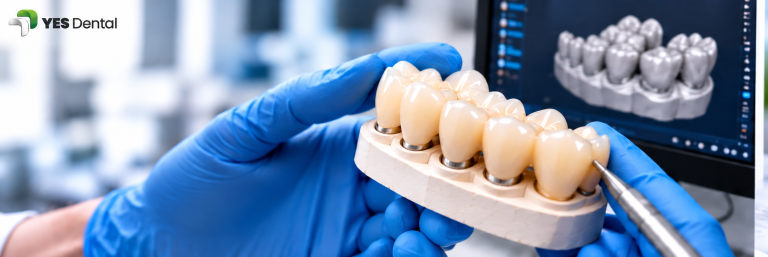
A dental crown is a custom-made restoration that covers a prepared natural tooth or is attached to an implant through an appropriate abutment or component. It restores the tooth’s shape, function and appearance.
Crowns may be recommended for teeth that are severely damaged, heavily restored, fractured or otherwise unsuitable for a simpler restoration. Implant crowns replace the visible tooth portion of a missing tooth supported by a dental implant.
Common crown materials include:
- Zirconia: a ceramic material available in different strength and translucency options.
- Porcelain-fused-to-metal (PFM): a metal framework covered with porcelain.
- Lithium disilicate: a glass-ceramic material used for selected aesthetic restorations.
- Metal alloys: used in appropriate cases where strength and material properties are priorities.
The material depends on the tooth’s position, available space, bite, aesthetic requirements and the dentist’s clinical assessment. Learn more in our guide to zirconia crowns.
What Is a Denture?
A denture is a removable prosthesis that replaces missing teeth and, where needed, supports or replaces parts of the surrounding oral tissues.
There are two main types:
- Complete denture: replaces all teeth in the upper or lower arch.
- Removable partial denture (RPD): replaces some missing teeth while using remaining teeth, tissues or other suitable support for retention and stability.
Dentures may be made using acrylic resin, metal frameworks or other suitable materials, depending on their design. Conventional and digital workflows can both be used where appropriate.
Some dentures are supported by dental implants. Implant-retained overdentures are removable by the patient, whereas fixed full-arch implant restorations are designed to remain in place and are not conventional removable dentures.
Crown vs Denture: Key Differences
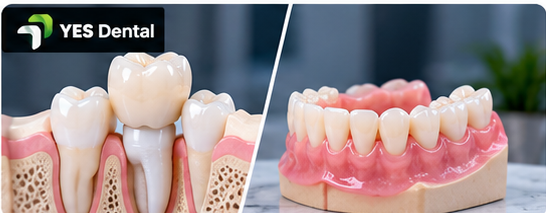
| Feature | Dental Crown | Denture |
|---|---|---|
| Primary purpose | Restores a damaged tooth or an implant | Replaces missing teeth |
| Placement | Fixed to a tooth or implant component | Removable, or implant-retained in some designs |
| Support | Natural tooth or implant | Oral tissues, remaining teeth or implants |
| Number of teeth | Often one tooth, although crowns can be part of a larger restoration | Several or all missing teeth |
| Common materials | Zirconia, PFM, glass-ceramic or metal | Acrylic resin, metal framework or other suitable materials |
| Daily care | Oral hygiene and regular dental reviews | Removal and cleaning when designed as a removable prosthesis |
| Maintenance | May require repair or replacement over time | May require adjustments, relining or replacement as conditions change |
| Digital production | Commonly compatible with digital workflows | Digital workflows are available for selected designs |
Neither option is automatically better. Each addresses a different restorative need, and the appropriate choice depends on the clinical situation.
Can You Put a Crown on a Denture?
Not usually in the sense of placing a conventional crown directly onto a removable denture. However, crowns and dentures can be designed to work together.
Common examples include:
1. Surveyed or abutment crowns
These crowns are designed for use with a removable partial denture. Their contours, guide planes and rest seats can help the denture fit and function as planned.
2. Telescopic crown-retained dentures
These use a primary crown fixed to a prepared tooth and a corresponding secondary component incorporated into the removable prosthesis. The design can provide retention and support, depending on the case.
3. Attachment-retained partial dentures
Special attachments may connect a removable prosthesis to suitable crowns or other supporting components. Their selection requires appropriate clinical and laboratory planning.
4. Implant-retained overdentures
Dental implants can improve denture retention through compatible attachment systems. The required components depend on the implant system and the prescribed design.
These combined treatments require coordination between the dentist and dental laboratory. The design of the supporting crowns, denture and retention components must be considered together rather than treated as unrelated restorations.
How Do Dentists Decide Between a Crown, Denture or Combination?
The decision depends on the patient’s clinical findings, treatment goals and ability to maintain the restoration.
| Clinical situation | Options the dentist may consider |
|---|---|
| One damaged but restorable tooth | Dental crown or another suitable restoration |
| One missing tooth | Implant crown or fixed bridge, where appropriate |
| Several missing teeth | Fixed bridge or removable partial denture |
| Missing teeth with suitable supporting teeth | Partial denture with a planned support and retention design |
| All teeth missing in an arch | Complete denture, implant-retained overdenture or fixed full-arch restoration |
| Complex tooth loss and existing restorations | A coordinated combination of crowns, implants and removable prostheses |
Before deciding, the dentist should assess:
- The number and position of missing teeth.
- The health and suitability of potential supporting teeth.
- Bone availability and implant suitability, where relevant.
- The patient’s preference for fixed or removable treatment.
- Oral hygiene, dexterity and maintenance requirements.
- Treatment cost, expected function and long-term follow-up.
The final plan should be based on a clinical examination and the patient’s individual needs.
What Can a Dental Laboratory Provide?
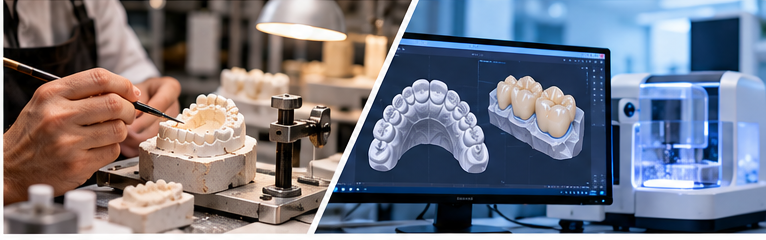
The laboratory’s role is to manufacture restorations according to the dentist’s prescription, case records and approved design.
| Restorative requirement | Potential laboratory output |
|---|---|
| Single-tooth restoration | Crown |
| Multiple teeth requiring fixed restorations | Crown and bridge restorations |
| Implant-supported tooth replacement | Implant crown or implant-supported bridge |
| Removable partial or complete tooth replacement | Removable restorations, subject to the laboratory’s capabilities |
| Full-arch tooth replacement | A prescribed full-arch restoration, where offered |
| Protection against bruxism | Night guard, where offered |
Specialised surveyed crowns, telescopic systems, precision attachments, overdenture bars and custom implant components require specific expertise, compatible components and a suitable workflow. Confirm availability with the laboratory before promising a particular design.
Explore the YES Dental Crown & Bridge range and the wider dental products range to review the relevant product categories.
Working With YES Dental
YES Dental provides dental restoration products and manufacturing solutions for dentists, clinics and dental laboratories. Its product categories include crown and bridge restorations, implant restorations, removable restorations and night guards.
For cases involving more than one restoration type, provide a clear prescription and the required supporting information. Depending on the case, this may include scans or impressions, opposing arch records, bite registration, shade details, implant information and special instructions.
For guidance about product availability or case requirements, contact YES Dental.
Clinics can also submit a case through the YES Dental case submission portal.
Conclusion
Crowns and dentures serve different purposes but can work together in a coordinated restorative treatment plan. Crowns restore individual teeth or implant-supported teeth, while dentures replace multiple or all missing teeth. The right choice depends on the patient’s clinical condition, supporting structures, functional needs and long-term maintenance.
For dentists and clinics, clear communication with the dental laboratory is essential when planning crowns, dentures or combined restorations. Accurate prescriptions and complete case information help the laboratory understand the intended design and manufacture the prescribed restoration.
Frequently Asked Questions
1. What is the main difference between a crown and a denture?
A crown is a fixed restoration that covers a damaged tooth or restores an implant. A denture replaces missing teeth and is generally removable, although implant-supported treatment can also include fixed full-arch restorations.
2. Can a crown support a removable partial denture?
Yes. In selected cases, a crown can be designed with specific contours, rests or attachment components to support or retain a removable partial denture. The dentist and laboratory should coordinate the design.
3. Is a crown better than a denture?
Neither is universally better. A crown may suit a damaged tooth that can be restored, while a denture may be appropriate when several or all teeth are missing. The choice depends on clinical findings, treatment goals and maintenance requirements.
4. What is a telescopic crown denture?
A telescopic crown denture uses a primary crown fixed to a supporting tooth and a corresponding secondary component incorporated into the removable prosthesis. It is a specialised option that requires careful planning and compatible laboratory fabrication.
5. Are implant-supported dentures better than conventional dentures?
Implant-supported overdentures can improve retention and stability for suitable patients, but they require implant surgery, appropriate supporting anatomy, maintenance and additional investment. The best option depends on the patient’s clinical condition and preferences.