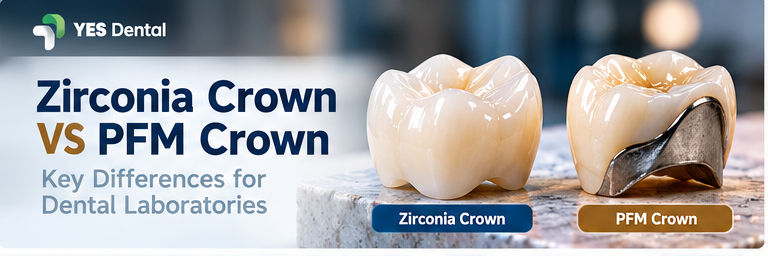
Choosing the right material for a dental crown involves more than comparing appearance or strength. For dental laboratories, the choice between a zirconia crown and a porcelain-fused-to-metal (PFM) crown can affect CAD design, material thickness, manufacturing workflow, esthetics, functional requirements and the final restoration.
Both zirconia and PFM have established roles in fixed dental restorations. The appropriate option depends on the clinical situation, preparation, restoration design, material requirements, occlusion, esthetic expectations and the laboratory’s production workflow.
For dental laboratories looking for both crown and bridge CAD design and manufacturing support, understanding the practical differences between zirconia and PFM can help create a more predictable digital workflow.
Quick Answer: Zirconia Crown vs PFM Crown
Zirconia crowns are ceramic restorations based on zirconium dioxide and can be produced using digital CAD/CAM workflows. They are available in different formulations and workflows, including monolithic zirconia and veneered zirconia.
PFM crowns, or porcelain-fused-to-metal crowns, combine a metal substructure with veneering porcelain. They have been used extensively in fixed prosthodontics and remain an established restoration option.
The key differences include:
| Feature | Zirconia Crown | PFM Crown |
|---|---|---|
| Core material | Zirconium dioxide ceramic | Metal alloy |
| Veneering | May be monolithic or veneered | Porcelain veneer over metal |
| Metal-free | Yes | No |
| CAD/CAM workflow | Commonly digitally designed and milled | Can involve digital CAD plus metal and porcelain workflow |
| Esthetics | Depends on zirconia type, shade and design | Depends on metal framework, porcelain layering and shade |
| Strength | High, depending on zirconia formulation and design | Established clinical performance |
| Digital design | Highly compatible with CAD/CAM | Can also be digitally designed |
| Typical workflow considerations | Thickness, connector design, occlusion, shade, sintering/finishing | Framework design, porcelain space, metal thickness, occlusion and layering |
| Main consideration | Material selection and digital design parameters | Framework and veneering ceramic requirements |
What Is a Zirconia Crown?
A zirconia crown is a fixed dental restoration made using zirconium dioxide-based ceramic.
Modern zirconia restorations can be designed digitally and manufactured using CAD/CAM workflows. Depending on the material and laboratory process, a zirconia crown may be produced as a monolithic restoration or may include a veneering ceramic.
For dental laboratories, zirconia crown CAD design typically requires attention to:
- Preparation geometry
- Margin definition
- Occlusal anatomy
- Proximal contacts
- Material thickness
- Functional clearance
- Emergence profile
- Occlusal relationship
- Shade requirements
- Manufacturing parameters
Research on zirconia restorations has reported favorable clinical performance, although outcomes vary according to restoration type, material, design and clinical conditions. A systematic review of zirconia-based crowns found five-year survival estimates of approximately 96% for tooth-supported zirconia crowns and approximately 97% for implant-supported zirconia crowns, while also noting technical and biological complications. More recent evidence continues to show generally favorable performance but emphasizes variation between restoration types and follow-up periods.
What Is a PFM Crown?
A PFM crown, short for porcelain-fused-to-metal crown, consists of a metal substructure covered with dental porcelain. The metal framework provides the underlying structure, while the veneering ceramic is used to create the external tooth-like appearance.
PFM crown design and manufacturing therefore involve considerations such as:
- Metal framework geometry
- Preparation reduction
- Metal thickness
- Porcelain space
- Margin design
- Functional anatomy
- Occlusal clearance
- Contact areas
- Ceramic layering
- Shade and characterization
PFM restorations have a long clinical history and remain an established option for fixed dental restorations.
Zirconia vs PFM: 8 Key Differences
1. Material Composition
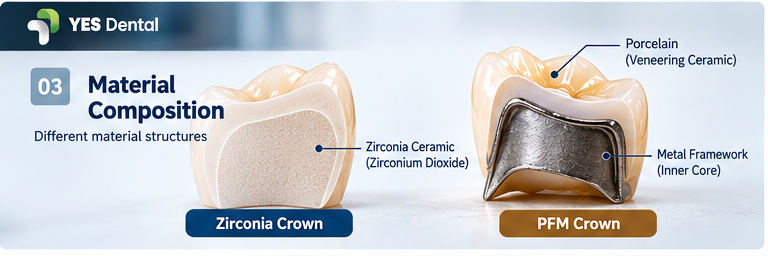
The most fundamental difference is the material structure.
Zirconia
Zirconia is a ceramic material based on zirconium dioxide. Depending on the selected material, it may be used as a monolithic restoration or as part of a veneered restoration.
PFM
PFM uses a metal framework covered by porcelain.
This difference affects the design and manufacturing workflow.
For zirconia, the laboratory must consider zirconia-specific parameters such as material thickness, sintering and finishing.
For PFM, the workflow must provide appropriate space and support for the metal framework and veneering porcelain.
2. Metal-Free vs Metal-Based Construction
A zirconia crown is a ceramic restoration and does not require a metal framework.
A PFM crown uses a metal substructure.
This distinction can be important when restoration requirements include a metal-free material option.
However, “metal-free” does not automatically mean that zirconia is the correct choice for every case. The restoration still needs to be selected according to clinical requirements, preparation, function, esthetics and material indications.
3. Esthetics and Optical Characteristics
Esthetics is one of the most commonly discussed differences between zirconia and PFM.
Modern zirconia materials have developed significantly, with different formulations designed to provide varying combinations of strength, translucency and optical characteristics.
PFM crowns use porcelain layering over a metal framework to reproduce tooth-like anatomy and appearance.
However, the final esthetic result depends on more than the material name.
It can also depend on:
- Preparation design
- Material thickness
- Shade selection
- Framework design
- Ceramic layering
- Translucency
- Surface characterization
- Finishing and polishing
- Laboratory technique
Therefore, it is more accurate to say that zirconia and PFM use different esthetic workflows, rather than claiming that one material always produces a better result.
4. CAD Design Workflow
Digital CAD design is an important part of the digital crown and bridge workflow.
Zirconia CAD workflow
A typical digital workflow may include:
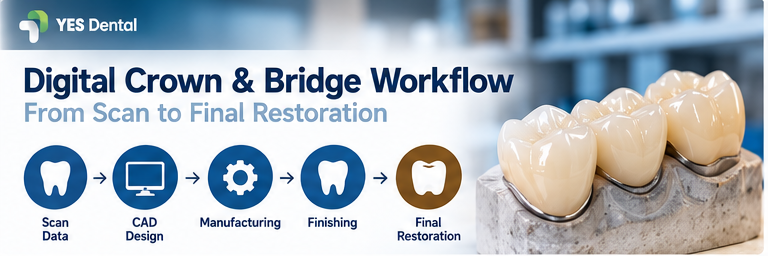
Scan data → CAD design → Design QC → CAM/milling → Sintering → Finishing → Final inspection
The dental CAD design process needs to consider:
- Margins
- Contacts
- Occlusion
- Anatomy
- Thickness
- Connector geometry for bridges
- Material requirements
PFM CAD workflow
A digital PFM workflow may include:
Scan data → Framework CAD → Design QC → Manufacturing → Ceramic application → Finishing → Final inspection
The CAD design must provide appropriate space for the metal framework and planned porcelain.
For dental laboratories, the CAD stage is therefore important for both materials, but the design parameters are not identical.
5. Strength and Functional Considerations
Zirconia is known for its mechanical properties, but strength should not be considered independently from restoration design.
Factors such as:
- Material formulation
- Thickness
- Restoration geometry
- Span
- Connector design
- Occlusion
- Preparation
- Manufacturing
- Finishing
can influence the performance of the final restoration.
A systematic review of monolithic CAD/CAM zirconia restorations reported favorable short-term survival in the studies reviewed, while also noting limitations in the available evidence and variation between studies.
PFM restorations also have a substantial clinical evidence base. Comparative evidence does not support a simplistic conclusion that zirconia universally outperforms PFM in every situation. Earlier systematic evidence found zirconia-based crowns to have clinical success comparable to conventional PFM restorations, while noting limitations in the available studies.
6. Veneering and Chipping Considerations
The way the restoration is constructed matters.
A monolithic zirconia crown is primarily formed from zirconia without a separate external porcelain veneer.
A veneered zirconia restoration includes a veneering ceramic.
PFM restorations also rely on porcelain over the metal framework.
Because veneering introduces another material layer, the design needs to account for appropriate support and thickness.
Clinical reviews of zirconia restorations have identified veneering ceramic chipping among commonly reported technical complications, particularly in veneered zirconia restorations.
This is one reason why the distinction between monolithic zirconia and veneered zirconia is important when comparing restoration workflows.
7. Preparation and Space Requirements
Material selection affects how the available restorative space is managed.
A CAD designer must consider:
- Preparation geometry
- Minimum material thickness
- Occlusal clearance
- Axial clearance
- Margin position
- Functional contacts
- Esthetic requirements
For zirconia, the required design parameters depend on the specific zirconia material and manufacturer’s instructions.
For PFM, the design must accommodate both the metal framework and the planned porcelain layer.
Therefore, the laboratory should not apply exactly the same CAD parameters to every crown material.
8. Manufacturing Workflow
The manufacturing process is another important difference.
Zirconia
A simplified workflow may include:
- Digital scan received
- CAD design
- Design QC
- Milling
- Sintering
- Staining/glazing or finishing
- Final inspection
PFM
A simplified workflow may include:
- Digital or conventional case information received
- Framework design
- Metal framework production
- Framework finishing
- Porcelain application
- Firing
- Contouring
- Glazing/finishing
- Final inspection
The exact workflow varies by laboratory, material system and manufacturing process.
Zirconia vs PFM: Which Should a Dental Laboratory Choose?
There is no single answer that applies to every case.
A dental laboratory should consider:
Case requirements
What type of restoration is being produced?
Clinical prescription
What has been requested by the treating dentist?
Preparation
How much restorative space is available?
Occlusion
What functional conditions need to be considered?
Esthetic requirements
What optical and esthetic characteristics are required?
Material
Which specific zirconia or PFM system is being used?
Manufacturing workflow
What equipment and finishing process are available?
Design requirements
Does the CAD design provide appropriate thickness, contacts, anatomy and clearance?
The final material selection should be made by the treating dental professional based on the clinical situation and appropriate material guidance.
Zirconia vs PFM for Dental Laboratories
For a dental laboratory, the comparison is not simply:
“Which crown is stronger?”
The more useful question is:
Which material and workflow best match the prescription, preparation, functional requirements, esthetic expectations and manufacturing process for the case?
This is where a structured digital workflow becomes important.
A laboratory receiving a digital crown or bridge case should have clear information about:
- Restoration type
- Material
- Shade
- Margin requirements
- Contacts
- Occlusion
- Preparation
- Special instructions
- Required delivery format
- Manufacturing requirements
Clear case instructions reduce ambiguity between the laboratory, CAD designer and manufacturing workflow.
How CAD Design Affects Zirconia and PFM Crowns
The CAD stage is an important part of the digital crown and bridge workflow.
For zirconia CAD design, the focus may include:
- Accurate margin identification
- Proper material thickness
- Functional anatomy
- Proximal contacts
- Occlusal clearance
- Emergence profile
- Connector design for bridges
For PFM CAD design, the framework design needs to consider:
- Metal thickness
- Porcelain space
- Support for veneering ceramic
- Margins
- Contacts
- Occlusion
- Functional anatomy
At YES Dental, crown and bridge CAD design support is structured around digital scan data, case instructions, restoration type, material requirements, margins, contacts, occlusion and production workflow.
Zirconia vs PFM: Quick Decision Framework
| Consideration | Zirconia | PFM |
|---|---|---|
| Metal-free requirement | Suitable | Not suitable |
| Digital CAD workflow | Strong fit | Also possible |
| Monolithic option | Yes | No |
| Veneering ceramic | Optional depending on system | Core part of restoration |
| Framework | Zirconia restoration itself | Metal substructure |
| Esthetic workflow | Material-specific translucency/shading | Porcelain layering |
| Material thickness | Zirconia-specific requirements | Metal + porcelain requirements |
| Manufacturing workflow | Milling + sintering/finishing | Framework + porcelain workflow |
| Case selection | Depends on material and clinical requirements | Depends on clinical requirements |
| CAD QC | Margins, contacts, thickness, occlusion | Framework, porcelain space, margins, contacts, occlusion |
Frequently Asked Questions
Is zirconia better than PFM?
Neither material is universally better for every case. Zirconia and PFM have different material structures and workflows, and the appropriate option depends on clinical requirements, preparation, occlusion, esthetics, material specifications and the treating professional’s prescription.
Is zirconia stronger than PFM?
Zirconia has high mechanical strength, but restoration performance depends on the specific material, design, thickness, manufacturing process and clinical conditions. PFM also has extensive clinical use and evidence. Material strength alone should not determine selection.
Are zirconia crowns metal-free?
Yes. Zirconia crowns are ceramic restorations based on zirconium dioxide and do not require a metal framework.
Do PFM crowns contain metal?
Yes. A PFM crown uses a metal substructure covered with porcelain.
Can zirconia crowns be designed using CAD/CAM?
Yes. Zirconia crowns are commonly integrated into digital CAD/CAM workflows involving digital scan data, CAD design, milling and subsequent finishing or sintering steps.
Can PFM crowns be digitally designed?
Yes. Digital CAD can be used to design the metal framework and establish the geometry and space required for the planned porcelain.
Which is more aesthetic, zirconia or PFM?
The answer depends on the specific material, restoration design, shade, preparation, manufacturing technique and characterization. Modern zirconia systems offer different optical properties, while PFM restorations use porcelain layering over a metal framework.
What information should a dental laboratory provide for a zirconia or PFM CAD case?
The case should include the required restoration type, scan data, prescription, material, shade information and relevant design or functional instructions. Additional requirements depend on the case and laboratory workflow.
Can the same CAD design parameters be used for zirconia and PFM?
No. The design should account for the specific material and manufacturing workflow. Zirconia and PFM have different structural requirements, particularly regarding material thickness, framework geometry and veneering space.
Does YES Dental provide crown and bridge CAD design?
YES Dental provides digital crown and bridge CAD design support for dental laboratories, including restoration types such as full zirconia crowns, zirconia bridges, PFM crowns, PMMA bridges, veneers, e.max crowns, full metal crowns and inlays/onlays.
Does YES Dental also provide crown and bridge manufacturing?
Yes. YES Dental’s Crown & Bridge service combines digital CAD design support with manufacturing workflows for selected crown and bridge restorations.