
Zirconia crown preparation requires a clear finish line, adequate and even tooth reduction, rounded internal angles and sufficient space for the selected material. The correct preparation depends on the zirconia product, tooth position, bite forces, restoration design and the manufacturer’s instructions.
For dentists, the goal is to preserve healthy tooth structure while providing enough space for a restoration that can be designed, manufactured and seated as prescribed. A clear scan or impression and complete case information also help the dental laboratory assess the preparation accurately.
This guide explains zirconia crown margin designs, occlusal and axial reduction, material-specific thickness requirements, common preparation mistakes and the records to send to your dental laboratory.
Key Takeaways
- Margin design: Chamfer and shoulder preparations with rounded internal angles are commonly recommended for zirconia restorations.
- Even reduction: Follow the tooth’s anatomy and provide sufficient space for the prescribed crown.
- Minimum thickness: Use the instructions for the specific zirconia material rather than relying on a universal thickness chart.
- Retention: Consider preparation height, taper, undercuts and the planned cementation approach.
- Digital records: Capture a continuous, clearly visible finish line, the opposing arch and an accurate bite record.
1. What Is Zirconia Crown Preparation?
Zirconia crown preparation is the process of shaping a natural tooth to accommodate a custom-made zirconia restoration. It establishes the space, finish line and geometry required for the crown to fit the prepared tooth and function as intended.
Zirconia is a ceramic material available in different formulations with varying strength and translucency. These differences affect the material’s indications, minimum restoration thickness and suitability for particular clinical situations.
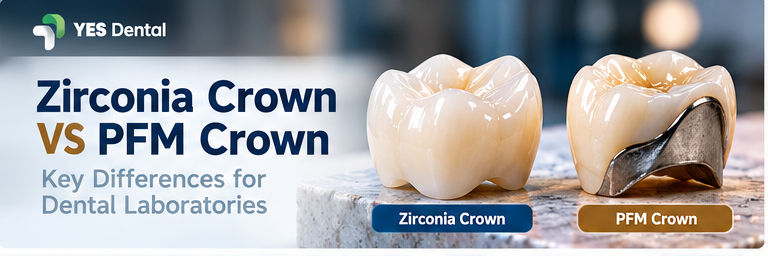
Compared with porcelain-fused-to-metal (PFM) restorations, zirconia crowns do not require space for a metal framework. However, they still need adequate material thickness. Layered zirconia restorations also require space for the veneering ceramic.
The preparation should therefore be planned around the intended restoration, not simply around how much tooth structure can be removed.
For a broader comparison of material options, read our guide to zirconia crown vs PFM crown.
2. Which Margin Is Best for a Zirconia Crown?
The finish line must be smooth, continuous and clearly identifiable. A chamfer or shoulder with rounded internal angles is commonly recommended, but the most appropriate design depends on the material and the clinical situation.
| Margin design | Key considerations |
|---|---|
| Chamfer | Commonly used for zirconia crowns when it provides sufficient space and a clear finish line. |
| Rounded shoulder | Provides a defined finish line and may be appropriate when the restoration design requires additional material space near the margin. |
| Feather edge or knife edge | Requires careful case selection and agreement with the laboratory because the thin margin can be difficult to capture and finish accurately. |
| Sharp internal shoulder | Generally avoided because sharp internal angles can complicate milling and create unfavourable stress concentrations. |
Practical margin guidelines
- Create a smooth, continuous finish line that can be identified clearly.
- Round internal line angles and avoid abrupt transitions.
- Ensure that the selected margin design provides adequate space for the prescribed material.
- Manage soft tissue carefully when the margin is at or below the gingival level.
- Discuss less conventional margin designs with the laboratory before proceeding.
A margin should not be selected in isolation. It must work with the tooth anatomy, material requirements, retention needs and intended restoration design.
3. Occlusal and Axial Reduction
Occlusal reduction creates space at the biting surface, while axial reduction creates space along the sides of the prepared tooth. Both should be sufficient and appropriately distributed for the selected crown.
Occlusal reduction
Reduction should follow the natural cusp and groove anatomy rather than creating a flat occlusal surface.
Insufficient clearance can force the laboratory to compromise between the prescribed crown thickness, external contours and occlusion. Uneven reduction may also leave localised areas with inadequate material thickness.
Practical considerations include:
- Use depth cuts or an appropriate reduction guide where helpful.
- Follow the cusp anatomy and functional surfaces.
- Check clearance against the opposing dentition.
- Consider the prescribed material and the patient’s occlusal loading.
- Verify that the available space is suitable for the intended restoration before submission.
Axial reduction
Axial reduction should provide sufficient space for the crown walls without unnecessarily sacrificing healthy tooth structure.
The preparation should have smooth, continuous surfaces and a suitable path of insertion. Excessive taper can compromise retention, while undercuts may prevent the crown from seating completely unless appropriately addressed in the design.
Important: Do not apply a single reduction measurement to every zirconia crown. Follow the selected material’s instructions for use and the clinical requirements of the case.
4. Minimum Thickness by Zirconia Type
There is no single minimum-thickness value that applies to every zirconia product. Requirements vary by manufacturer, material formulation, restoration type, processing workflow and clinical indication.
The following table is a general material-selection guide, not a substitute for the manufacturer’s technical documentation.
| Zirconia category | General characteristics | Preparation considerations |
|---|---|---|
| 3Y zirconia | Generally prioritises strength over translucency. | May be considered where strength and restricted restorative space are important, subject to the product’s indications. |
| 4Y zirconia | Offers an intermediate balance of strength and translucency. | Assess the material’s specified thickness, tooth position and functional loading. |
| 5Y zirconia | Generally offers higher translucency, with lower strength than many high-strength 3Y formulations. | Confirm suitability for the restoration type, available space and expected loading. |
These categories are broad descriptions. Actual properties and approved indications differ among products, including multilayer materials that combine different zirconia formulations.
How to confirm the required thickness
Before preparing the tooth or finalising the restoration design:
- Identify the exact zirconia product and intended restoration type.
- Review the manufacturer’s instructions for use and preparation guidelines.
- Confirm the required space at the occlusal, axial and marginal areas.
- Consider whether the restoration is monolithic or layered.
- Discuss restricted space or unusual clinical requirements with the laboratory before manufacturing.
If adequate space cannot be achieved, the dentist should reassess the material or treatment plan rather than assume that every zirconia product can be manufactured safely at a reduced thickness.
5. Taper, Line Angles and Retention
Preparation geometry affects the crown’s path of insertion, seating and retention.
Taper: Provide an appropriate convergence of the axial walls. Excessive taper can reduce retention, while insufficient clearance or unsuitable geometry can create seating problems.
Internal line angles: Round internal transitions to support accurate digital design and milling.
Preparation height: Adequate axial wall height can improve retention. Short clinical crowns may require additional consideration of preparation design and the intended cementation approach.
Undercuts: Identify and manage undercuts according to the clinical plan and restoration design.
Retention features: Grooves or boxes may be considered in selected cases when additional resistance or retention is needed.
The preparation must also be compatible with the planned cementation protocol. Follow the material manufacturer’s instructions and the dentist’s clinical judgement when selecting the appropriate approach.
6. Scan and Impression Guidelines for Zirconia Crowns
Even a well-prepared tooth can be difficult to restore accurately if the laboratory receives incomplete or unclear records.
For digital workflows, capture the entire preparation and finish line without gaps, distortion or missing data. For conventional workflows, ensure the impression accurately reproduces the same critical details.
Before submitting a digital case
- Expose the finish line: Manage soft tissue and moisture so the margin can be captured clearly.
- Inspect the preparation scan: Check for missing areas, holes, artefacts and unclear margins.
- Capture adjacent teeth: Include the information needed to assess proximal contacts.
- Include the opposing arch: Provide the records required to plan the occlusion.
- Record the bite: Submit an accurate bite registration according to the workflow.
- Communicate the shade: Include the prescribed shade and photographs where useful.
- Add special instructions: Note relevant design preferences, clinical constraints and material requirements.
7. Common Zirconia Crown Preparation Mistakes
| Common issue | Potential consequence | Recommended action |
|---|---|---|
| Insufficient occlusal clearance | The design may not accommodate the prescribed material thickness. | Reassess clearance before finalising the preparation. |
| Uneven reduction | Inconsistent space for the restoration. | Follow tooth anatomy and check clearance across the preparation. |
| Sharp internal angles | More difficult milling and unfavourable stress concentration. | Round internal transitions. |
| Unclear finish line | Difficult margin identification and possible design or fit problems. | Improve visibility and capture a complete margin record. |
| Excessive taper | Reduced preparation retention. | Review preparation geometry and the planned cementation approach. |
| Unmanaged undercuts | Potential interference with the crown’s path of insertion. | Assess the preparation and address undercuts appropriately. |
| Missing opposing arch or bite record | Incomplete information for occlusal design. | Include the required opposing and bite records. |
| Unspecified material | Uncertainty about the appropriate design and thickness requirements. | Confirm the exact material and restoration prescription. |
These issues do not automatically lead to a failed restoration, but they can make design and manufacturing more difficult. Early identification gives the dentist and laboratory an opportunity to clarify the case before production.
8. Which Preparation Approach Fits Your Case?
The appropriate preparation depends on the clinical requirements rather than a universal protocol.
- Posterior crown: Consider functional loading, available occlusal space, tooth anatomy and the prescribed zirconia’s indications.
- Anterior crown: Balance material thickness with aesthetic requirements, shade communication and the planned restoration design.
- Restricted restorative space: Confirm the material’s minimum requirements before proceeding. Do not assume a more translucent zirconia will tolerate the same reduction as a higher-strength formulation.
- Short clinical crown: Assess preparation height, taper and the planned retention and cementation approach.
- Bridge restoration: Consider the span, connector design, abutments and material-specific indications in addition to the preparation of individual teeth.
- Implant-supported crown: Follow the implant system’s restorative requirements and provide the correct implant or scan-body information. Conventional natural-tooth preparation rules do not directly apply to an implant fixture.
The final decision should reflect the clinical examination, the dentist’s prescription, the selected material’s instructions and the laboratory’s manufacturing requirements.
9. Working With YES Dental
YES Dental provides dental restoration products and manufacturing solutions for dentists, clinics and dental laboratories. Its product categories include crown and bridge restorations, implant restorations, removable restorations and night guards.
When submitting a zirconia crown case, provide the prescription, selected material where specified, preparation scan or impression, opposing arch, bite record, shade information and any relevant design instructions.
If the case involves restricted space, an unusual margin design or a material-specific requirement, include that information in the prescription so it can be considered during case assessment.
Explore the YES Dental Crown & Bridge range or submit your case through the YES Dental portal.
Conclusion
Successful zirconia crown preparation depends on clear margins, appropriate preparation geometry, adequate restorative space and accurate case records. Because zirconia products differ in strength, translucency and approved indications, material-specific instructions should guide the final preparation rather than a universal thickness chart.
For dentists and dental laboratories, discussing the material and restoration design before manufacturing can help identify missing information and avoid preventable workflow complications.
Planning a zirconia crown case? Review the prescription and material requirements, prepare complete case records and submit your case to YES Dental.
Frequently Asked Questions
1. What are the main zirconia crown preparation guidelines?
Provide sufficient and even reduction, a clear and continuous finish line, rounded internal angles and appropriate preparation geometry. Confirm the required space against the instructions for the exact zirconia product and restoration type.
2. How thick should a zirconia crown be?
The required thickness depends on the specific material, manufacturer, restoration design and clinical loading. Do not rely on a universal thickness figure for all zirconia crowns; check the product’s instructions for use.
3. Which margin is best for a zirconia crown?
A chamfer or shoulder with rounded internal angles is commonly recommended. The appropriate margin depends on the material, available restorative space and clinical requirements. Discuss a feather-edge preparation with the laboratory before choosing that approach.
4. Does zirconia require less tooth reduction than PFM?
Zirconia does not require space for a metal framework, but it still needs sufficient thickness for the selected material and restoration design. The actual reduction requirement depends on the zirconia product and the PFM system being compared.
5. What information should be sent to the laboratory for a zirconia crown?
Provide the restoration prescription, preparation scan or impression, opposing arch, bite registration, shade details and relevant clinical instructions. Include the exact material where specified and any special requirements that may affect the design.