Removable partial dentures (RPDs) replace one or more missing teeth when some natural teeth remain in the dental arch. The three common options are acrylic partial dentures, cast metal partial dentures and flexible partial dentures. They differ in support, rigidity, comfort, repairability, appearance and cost.
Acrylic partial dentures are often considered for interim or budget-conscious treatment, cast metal frameworks for suitable long-term cases requiring rigidity and support, and flexible dentures for selected cases where appearance and flexibility are priorities. The right choice depends on the remaining teeth, tissue support, missing-tooth span, occlusion, patient expectations and clinical assessment.
What Is the Difference Between Acrylic, Cast Metal and Flexible Partial Dentures?
Acrylic, cast metal and flexible partial dentures differ in their structure, support, appearance, adjustability and maintenance requirements. Acrylic partial dentures are often considered for interim treatment or selected budget-conscious cases. Cast metal partial dentures use a rigid framework and may be suitable for definitive treatment when the remaining teeth and oral tissues can support the design. Flexible partial dentures offer a flexible, often metal-free appearance for selected cases, but adjustment, relining and repair may be more difficult. The appropriate option depends on the clinical assessment, remaining teeth, support conditions, occlusion, patient preferences and available materials.
Key Takeaways
- Acrylic partial dentures: often suitable for interim treatment, short-term use or cases where cost is a major consideration.
- Cast metal partial dentures: provide a rigid framework and can offer good support and stability when appropriately designed.
- Flexible partial dentures: offer a metal-free appearance and flexibility, but may be more difficult to adjust, reline or repair.
- No single design is suitable for every patient.
- Accurate impressions or scans, a reliable bite record and clear design instructions help the dental laboratory fabricate an appropriate appliance.
What Is a Removable Partial Denture?
A removable partial denture is a prosthesis that replaces one or more missing teeth in an arch where some natural teeth remain. The patient can remove it for cleaning and maintenance.
Depending on its design, an RPD may receive support from the remaining teeth, the oral tissues or a combination of both. The distribution of support, retention and stability depends on the clinical situation and the design of the appliance.
Before selecting a material, assess the remaining teeth, periodontal condition, missing-tooth span, available support, occlusion, hygiene and the patient’s expectations.
Acrylic vs Cast Metal vs Flexible Partial Dentures: Comparison Chart
| Feature | Acrylic partial denture | Cast metal partial denture | Flexible partial denture |
|---|---|---|---|
| Main structure | Acrylic base with artificial teeth, often with wire clasps | Rigid metal framework supporting acrylic and artificial teeth | Flexible thermoplastic resin with flexible clasps |
| Rigidity | Relatively low | High | Flexible by design |
| Thickness and bulk | Often bulkier | Framework can be relatively thin | Often thin and lightweight |
| Support | Frequently tissue-supported, depending on design | Can use rests and tooth support alongside tissue support | Often relies substantially on tissue support |
| Aesthetics | Wire clasps may be visible | Metal clasps may be visible | Gum-coloured clasps may blend with the tissues |
| Initial comfort | Depends on fit and adaptation | Usually requires an adaptation period | May feel comfortable for some patients |
| Repair and modification | Often relatively straightforward | Possible, but depends on framework and damage | May be more difficult; some designs require replacement |
| Relining | Often possible | May be possible, depending on the design | Can be difficult or material-dependent |
| Durability | May fracture or loosen over time | Rigid framework can provide good durability when properly designed | Depends on resin, design, use and maintenance |
| Typical use | Interim, short-term or selected budget-conscious cases | Suitable definitive cases requiring a rigid framework | Selected cases prioritising flexibility and appearance |
| Relative cost | Often the lowest | Often the highest | Varies by material and fabrication method |
These are general comparisons, not guarantees. Actual performance depends on the material, design, clinical conditions, laboratory process and patient maintenance.
1. Acrylic Partial Dentures
An acrylic partial denture uses an acrylic resin base to support artificial teeth. Retention may be provided by wire clasps or other design features, depending on the case.
Advantages
- Often economical compared with cast metal alternatives.
- Can be useful for interim tooth replacement.
- May allow teeth to be added or the appliance to be modified when clinically and technically feasible.
- Can be considered when future dental treatment may change the design.
Limitations
- The base may be bulkier than a cast metal framework.
- Acrylic can fracture under repeated loading or if the design is inadequate.
- Support and stability depend on the remaining teeth, tissue conditions and appliance design.
- Fit may change as the tissues or remaining teeth change.
When might an acrylic partial denture be considered?
Acrylic partial dentures may be considered for interim treatment following an extraction, short-term tooth replacement, or selected cases where affordability and future modification are important.
They are not automatically the best option for every temporary case. The clinician should consider the healing stage, remaining teeth, tissue support and the patient’s ability to maintain the appliance.
2. Cast Metal Partial Dentures
A cast metal partial denture uses a rigid framework, commonly made from a cobalt-chromium alloy, to connect and support the denture components. The framework may incorporate rests, clasps and major connectors according to the prescribed design.
Advantages
- A rigid framework can provide stability when properly designed.
- Rests can help direct and distribute forces through suitable supporting teeth.
- Framework components can be relatively thin compared with a bulky acrylic base.
- May be appropriate for long-term definitive treatment when the oral conditions support this design.
Limitations
- Often costs more than an acrylic partial denture.
- Requires careful design, accurate records and additional laboratory steps.
- Metal clasps may be visible, depending on their position.
- Changes to the framework can be more complicated than modifications to a simple acrylic appliance.
When might a cast metal partial denture be considered?
Cast metal frameworks are commonly considered for suitable definitive cases, including selected longer-span and distal-extension situations. Their success depends on the condition of the remaining teeth, periodontal support, framework design, occlusion and maintenance.
A cast metal framework should not be selected solely because it is rigid. The clinician must determine whether the remaining teeth and tissues can support the planned design.
3. Flexible Partial Dentures
A flexible partial denture is made from a thermoplastic resin that can bend to some degree. Its clasps may be made from a gum-coloured material, which can reduce the visibility of metal clasps in selected cases.
Advantages
- Metal-free appearance when the selected material and design contain no metal components.
- Flexible construction may feel comfortable to some patients.
- Gum-coloured clasps may blend with surrounding tissues.
- Can be considered for selected cases where appearance is a priority.
Limitations
- Provides less rigid support than a conventional cast metal framework.
- Adjustment, relining and repair can be more difficult, depending on the material.
- Adding a tooth or modifying the appliance may require laboratory assessment or replacement.
- Flexibility does not guarantee improved stability or suitability for every missing-tooth pattern.
When might a flexible partial denture be considered?
Flexible partial dentures may be considered for selected short-span cases where the support conditions are favourable and the patient prioritises a metal-free appearance.
They require particular caution in long distal-extension or free-end saddle situations, especially when support is limited. Their flexibility may make movement more difficult to control than with a well-designed rigid framework.
Important: a history of metal allergy should be assessed carefully. Confirm the composition of the proposed appliance and consider an appropriate alternative with the treating clinician rather than assuming every flexible denture is suitable.
Which Partial Denture Should You Choose?
The following chart provides a starting point for clinical discussion. The final decision depends on examination, diagnosis, support conditions and the prescribed design.
| Clinical situation | Option to consider |
|---|---|
| Recent extraction requiring interim tooth replacement | Acrylic partial denture, when clinically appropriate |
| Suitable long-term case requiring a rigid framework | Cast metal partial denture |
| Distal-extension or free-end saddle requiring controlled support | A carefully designed cast metal framework may be considered |
| Short span where a metal-free appearance is important | Flexible or another suitable metal-free design |
| Patient has a confirmed metal allergy | Verify material composition and consider an appropriate alternative |
| Budget is a major constraint | Acrylic partial denture, depending on clinical suitability |
| Further tooth loss or treatment is anticipated | A design that can be modified appropriately, after planning for the expected changes |
| Significant occlusal loading | Assess support, design and material carefully; do not select based on material alone |
Factors to assess before prescribing
Before choosing an RPD, consider:
- Remaining teeth: their condition, mobility, periodontal support and expected prognosis.
- Support and retention: whether the denture will be supported by teeth, tissues or both.
- Missing-tooth span: including whether the case includes a distal-extension saddle.
- Occlusion: available space, opposing teeth and relevant functional loading.
- Aesthetics: clasp visibility, tooth shade and the appearance of the denture base.
- Patient factors: comfort, dexterity, oral hygiene, expectations and budget.
- Maintenance: likely future changes, repair options and the patient’s ability to attend reviews.
What Does Your Dental Laboratory Need?
A complete prescription helps the laboratory understand the intended design and identify missing information before fabrication.
Case submission checklist
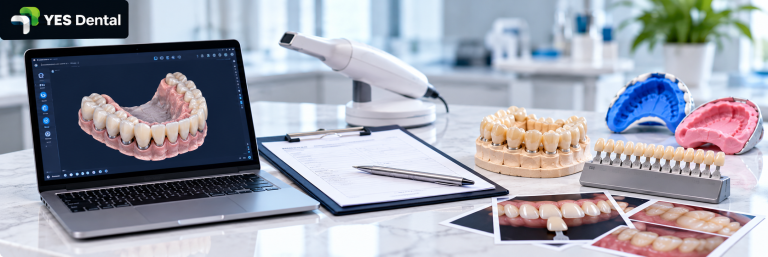
- Accurate impressions or scans: Provide adequate detail of both arches, including the remaining teeth and the tissues relevant to the denture-bearing area.
- Bite registration: Supply a reliable record of the required occlusal relationship and vertical dimension where relevant.
- Design instructions: Specify the intended support, clasp positions, rests and major connector, or arrange to discuss the design with the laboratory.
- Artificial tooth selection: Include shade, mould or shape, and size where known.
- Material preference: State whether acrylic, cast metal or flexible material is requested, subject to clinical suitability and laboratory availability.
- Try-in requirements: Specify whether a framework try-in or wax try-in is required before processing.
- Remaining-tooth information: Document mobility, planned extractions, existing restorations or teeth with a questionable prognosis.
- Aesthetic requirements: Note concerns about clasp visibility, tooth arrangement and gum color.
For a more detailed checklist of impressions, scans, prescriptions and other information to include when submitting a case, read our dental case submission guide.
Common Mistakes When Prescribing Partial Dentures
| Common mistake | Potential problem | Better approach |
|---|---|---|
| Choosing a flexible denture without assessing support | Excessive movement or poor stability | Assess the span, support and suitability of the material |
| Inadequate tissue detail in the impression or scan | Poor fit or rocking | Check the records and retake them if necessary |
| Sending no design instructions | The laboratory may not understand the intended clasp or rest arrangement | Provide a clear prescription or discuss the design |
| Skipping a planned framework try-in | Fit or design issues may be identified late | Include the appropriate try-in stage for definitive cases |
| Incorrect bite registration | Occlusal discrepancies or discomfort | Verify the bite record and relevant jaw relationship |
| Omitting patient care instructions | Poor hygiene, staining or tissue irritation | Provide clear cleaning and maintenance advice |
Patient Care Instructions for Removable Partial Dentures
Explain the care routine when delivering the appliance. Instructions should reflect the material and the patient’s clinical needs.
- Remove and clean the denture regularly using a soft brush and a suitable denture-cleaning product.
- Avoid hot water and abrasive products that may damage or distort the appliance.
- Clean the remaining natural teeth thoroughly, paying attention to the teeth that support or retain the denture.
- Follow the clinician’s advice about whether to remove the appliance overnight.
- Store the denture according to the material manufacturer’s and clinician’s instructions.
- Attend regular reviews so that fit, oral tissues, supporting teeth and appliance condition can be checked.
- Contact the clinic if the denture cracks, becomes loose, causes persistent soreness or no longer fits properly.
Cleaning and storage instructions can differ by material. Do not assume that every flexible resin or acrylic appliance can be maintained with the same cleaning solution.
Working With YES Dental
YES Dental supplies dental restoration products to dentists and clinics, including removable restorations. When enquiring about a partial denture, share the case records, the intended material, design requirements and relevant details about the remaining teeth.
The available denture materials, framework options and modification capabilities should be confirmed with the team before the case is finalised. If the case involves a distal-extension saddle, limited support or anticipated future tooth loss, communicate these factors clearly so the design requirements can be reviewed.
Explore the YES Dental dental products range, read our hybrid dental workflow guide for information about digital and laboratory workflows, or contact YES Dental to discuss your requirements.
You can also submit a case through the YES Dental portal or contact the team through WhatsApp.
Conclusion
Choosing between acrylic, cast metal and flexible partial dentures means matching the appliance to the remaining teeth, support, missing-tooth span, occlusion, aesthetics and expected maintenance. Acrylic dentures may suit interim or selected budget-conscious cases, cast metal frameworks can provide rigidity for suitable definitive treatment, and flexible dentures may suit selected cases where appearance and flexibility are priorities.
Provide accurate records, a reliable bite and clear design instructions. Plan any required try-in and confirm the available material and design options with the dental laboratory before fabrication.
Frequently Asked Questions
1. What are the main types of removable partial dentures?
The three common types are acrylic partial dentures, cast metal framework dentures and flexible thermoplastic dentures. They differ in rigidity, support, aesthetics, repairability and cost.
2. Which type of partial denture is most durable?
A properly designed cast metal framework can provide good rigidity and durability in a suitable case. Longevity also depends on the supporting teeth, oral tissues, fit, maintenance and the patient’s use of the appliance.
3. Are flexible partial dentures better than cast metal dentures?
Not in every case. Flexible dentures may offer a metal-free appearance and comfort for selected patients, while cast metal frameworks provide greater rigidity. The most suitable option depends on support, span, design and clinical requirements.
4. Can a removable partial denture be repaired or modified?
Acrylic partial dentures can often be repaired or modified, and some cast metal dentures can also be repaired depending on the damage and framework. Flexible dentures may be harder to modify or reline. The laboratory should assess the appliance before confirming whether repair is possible.
5. Is a try-in necessary for a partial denture?
A try-in or framework verification stage can help identify issues with fit, design, tooth arrangement or aesthetics before final processing. The appropriate stage depends on the type of denture and the complexity of the case; follow the treatment plan and laboratory workflow.