A complete dental case submission includes the files, prescription details, shade information and clinical notes a dental lab needs to produce a restoration accurately. Providing complete and consistent information helps reduce avoidable questions, delays and remake risk while making communication between the clinic and laboratory more efficient.
What Is a Dental Case Submission?
A dental case submission is the information and clinical data sent by a dentist or clinic to a dental laboratory for the production of a restoration.
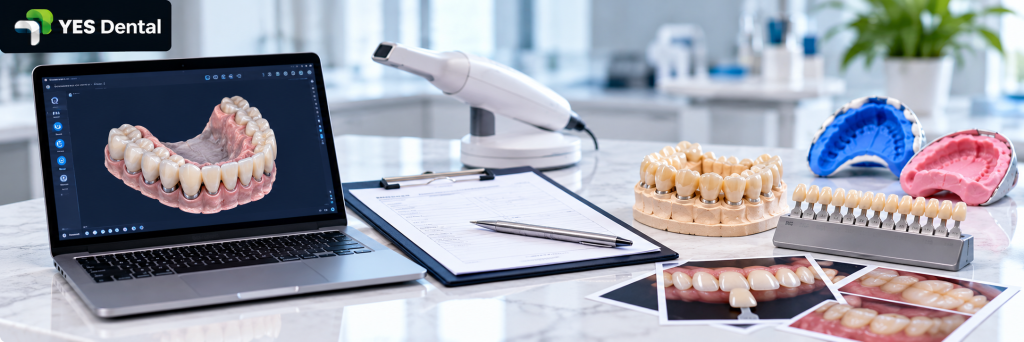
Depending on the case, this may include:
- Patient or case reference number
- Prescription details
- Intraoral scan files or physical impressions
- Upper and lower arch scans
- Bite registration
- Shade information
- Preparation details
- Implant information
- Restoration type and material
- Clinical photographs
- Special instructions
The exact requirements depend on the type of restoration being requested.
For clinics looking for a reliable laboratory partner, it is also useful to understand the factors involved in how to choose a dental lab, including quality control, communication, materials and turnaround time.
What Should You Include in Every Dental Case?
A good case submission should provide enough information for the laboratory to understand what needs to be made, how it should be made and what clinical requirements need to be followed.
1. Case and Clinic Details
Start with basic case information.
Include:
- Case ID or reference number
- Clinic or dentist name
- Contact details
- Required delivery date, when applicable
- Restoration type
- Any relevant case-specific instructions
Avoid sending unnecessary patient-identifying information. A case reference or ID is usually preferable when full patient information is not required.
2. Prescription Details
The prescription should clearly explain what restoration is required.
Depending on the case, specify:
- Tooth number
- Restoration type
- Material
- Shade
- Retention preference where applicable
- Occlusal requirements
- Contact requirements
- Pontic design for bridges
- Aesthetic requirements
- Any special clinical instructions
For example, simply writing “crown” may not provide enough information. A clearer prescription could specify the tooth, restoration type, material and shade.
3. Scan Files or Physical Impressions
For digital cases, provide the appropriate scan data required for the restoration.
A crown or bridge case may require:
- Prepared tooth or teeth
- Upper arch
- Lower or opposing arch
- Bite registration
- Pre-operative scan when relevant
- Scan body information for implant cases
Common digital file formats include STL, PLY and OBJ, although the accepted format depends on the laboratory’s workflow and software.
If you are working digitally, understanding the digital crown and bridge workflow can help ensure that the required information is captured before submission.
For physical cases, impressions should be properly disinfected, packaged and labelled according to the laboratory’s requirements.
4. Shade Information
Shade communication is particularly important for aesthetic restorations.
Whenever possible, provide:
- Selected shade
- Shade system used
- Clinical photographs
- Photographs showing adjacent teeth
- Appropriate lighting
- Preparation or stump shade when relevant
- Characterization requirements
Shade should ideally be assessed before significant dehydration of the teeth because dehydration can temporarily alter their appearance.
A clinical photograph can also give the dental laboratory additional information about surrounding teeth, translucency, characterization and other aesthetic details.
For restorations such as zirconia crowns, clear shade and aesthetic communication can be particularly useful because zirconia restorations are available in different material types and aesthetic configurations.
5. Special Instructions
Include any information that could affect the final restoration.
Examples include:
- Occlusal considerations
- Limited interocclusal space
- Heavy occlusion or bruxism
- Subgingival margins
- Contact preferences
- Pontic requirements
- Emergence profile
- Esthetic expectations
- Provisional restoration requirements
- Specific surface or characterization instructions
If something is important to the final result, do not assume the laboratory will know it without being told.
Case Requirements by Restoration Type
Different restorations require different information.
| Restoration | Important Information |
|---|---|
| Single Crown | Tooth number, preparation scan, opposing arch, bite, shade, material |
| Bridge | Abutment teeth, pontic position, preparation scans, bite, shade, material |
| Implant Crown | Implant system, scan body, implant position, opposing arch, bite, retention preference |
| Full-Arch / All-on-X | Full-arch scans, implant information, scan bodies, bite, vertical requirements, provisional requirements |
| Removable Denture | Arch scans or impressions, bite, tooth setup requirements, shade and design preferences |
| Night Guard | Required arch scans, opposing arch, bite registration and appliance requirements |
The more complex the restoration, the more important it becomes to provide complete case information before manufacturing begins.
How to Send Better Shade Information
Shade selection can become difficult when photographs or clinical information are unclear.
For better shade communication:
Use the correct shade guide
Clearly identify the shade system being used, such as VITA Classical or VITA 3D-MASTER where applicable.
Take photographs in suitable lighting
Avoid strong coloured lighting that can distort the appearance of the teeth.
Photograph before significant dehydration
Teeth can appear lighter after drying. Shade assessment should therefore be performed at an appropriate stage of the clinical procedure.
Include surrounding teeth
A photograph showing adjacent and opposing teeth can help the laboratory understand the overall colour relationship.
Add additional photographs when needed
For complex aesthetic cases, multiple photographs from different angles can provide useful context.
How to Submit Better Digital Scan Files
A good scan is more than simply generating an STL file.
Before submitting the case, check:
- Are the preparation margins clearly visible?
- Are there holes or missing areas in the scan?
- Is the opposing arch included?
- Is the bite registration accurate?
- Is the preparation completely captured?
- Are there excessive scan artifacts?
- Is the scan body fully seated in implant cases?
- Are all required files attached to the correct case?
A few minutes of checking the scan before submission can prevent unnecessary communication later.
Which Submission Method Is Best?
There is no single submission method that works for every clinic.
Digital-first clinics
Clinics using intraoral scanners can submit digital files electronically. This can simplify case communication and reduce the need for physical impressions when the laboratory and restoration workflow support digital submissions.
Clinics using physical impressions
Traditional impressions can still be used when required by the clinical situation or laboratory workflow. Packaging and labelling should be clear and secure.
Mixed workflows
Some clinics use digital scans for certain restorations and physical impressions for others. In these cases, the laboratory should clearly understand which files or physical components belong to each case.
High-volume clinics
Clinics submitting many cases should use consistent case IDs, prescription formats and submission procedures. A standardized process makes it easier for both the clinic and laboratory to track cases.
Common Dental Case Submission Mistakes
| Common Mistake | Why It Can Cause Problems |
|---|---|
| Missing opposing scan | Occlusion cannot be properly evaluated |
| Unclear shade | Additional communication may be required |
| Incorrect tooth number | Risk of producing the wrong restoration |
| Missing bite registration | Difficulties establishing the intended occlusion |
| Incomplete implant information | Laboratory may need clarification before proceeding |
| Poor scan quality | Margins or other important details may be unclear |
| No special instructions | Important clinical preferences may be missed |
| Multiple files without case IDs | Difficulties matching files to the correct case |
The goal is not to send as much information as possible. The goal is to send the right information clearly and consistently.
What Information Does a Dental Lab Need for an Implant Case?
Implant cases generally require more detailed information than a straightforward single crown.
Depending on the restoration, provide:
- Implant system and connection
- Implant position
- Scan body information
- Digital scan
- Opposing arch
- Bite registration
- Restoration type
- Screw-retained or cement-retained preference
- Material
- Shade
- Emergence or aesthetic requirements
- Any additional component requirements
For a broader understanding of implant-supported restorations, see our guide to implant restorations.
Working With YES Dental
YES Dental provides dental restoration products and manufacturing solutions for dentists, clinics and dental laboratories.
Its product range includes crown and bridge restoration, implant restorations, removable restorations and night guards.
Before submitting a case, clinics can review the available dental products products and select the appropriate restoration for their requirements.
For case-related questions or product enquiries, clinics can also contact YES Dental.
Cases can be submitted through the YES Dental case submission portal:
Dental Case Submission Checklist
Before sending a case to your dental laboratory, quickly check:
☐ Case ID is correct
☐ Tooth number is clearly specified
☐ Restoration type is mentioned
☐ Material is specified
☐ Shade is provided
☐ Preparation scan is complete
☐ Opposing arch is included
☐ Bite registration is included
☐ Implant information is included where required
☐ Clinical photographs are attached when necessary
☐ Special instructions are clearly written
☐ All files belong to the correct case
This simple checklist can help clinics avoid common submission problems and reduce unnecessary back-and-forth communication.
Conclusion
A successful dental case submission is complete, clear and consistent. The prescription, scan data, shade information and clinical instructions should give the dental laboratory enough information to understand the case without unnecessary clarification.
For clinics, creating a standardized submission checklist can make case communication easier, reduce avoidable delays and support a more predictable restoration workflow.
When submitting a case to YES Dental, make sure the required files and restoration instructions are clearly provided so the team can process the case efficiently.
Frequently Asked Questions
1. What do I need to send a dental lab for a crown?
For a crown case, typically provide the tooth number, preparation scan or impression, opposing arch, bite registration, restoration type, material and shade. Additional photographs or special instructions should be included when they are relevant to the case.
2. What file format should I send to a dental lab?
Common digital dental file formats include STL, PLY and OBJ. However, the accepted formats depend on the laboratory’s software and workflow, so confirm the required format before submitting the case.
3. How do I send a shade to a dental lab?
Provide the selected shade and shade system, along with clear clinical photographs when appropriate. Photos should be taken under suitable lighting and can include adjacent teeth and other relevant areas to provide additional aesthetic context.
4. Do I need a physical impression if I scan digitally?
Not necessarily. When the clinic and laboratory support a fully digital workflow, intraoral scan files can be submitted electronically instead of a physical impression. However, requirements can vary by restoration and workflow.
5. What information does a lab need for an implant crown?
An implant crown case may require the implant system, implant position, scan body information, digital scans, opposing arch, bite registration, retention preference, material and shade. The exact requirements depend on the implant system and restoration.