Preserving healthy tooth structure while providing adequate restorative strength is an important consideration in restorative dentistry. However, not every extensively damaged posterior tooth requires a full-coverage crown.
Inlays, onlays and overlays offer alternative restorative approaches when the remaining tooth structure, occlusal conditions and bonding requirements support partial coverage.
Successful dental inlay and onlay fabrication depends on appropriate restoration selection, preparation geometry, material thickness and communication between the dentist and dental laboratory. Even a well-manufactured ceramic restoration may require extensive adjustments if these requirements are not addressed before fabrication.
What Is the Difference Between an Inlay, Onlay and Overlay?
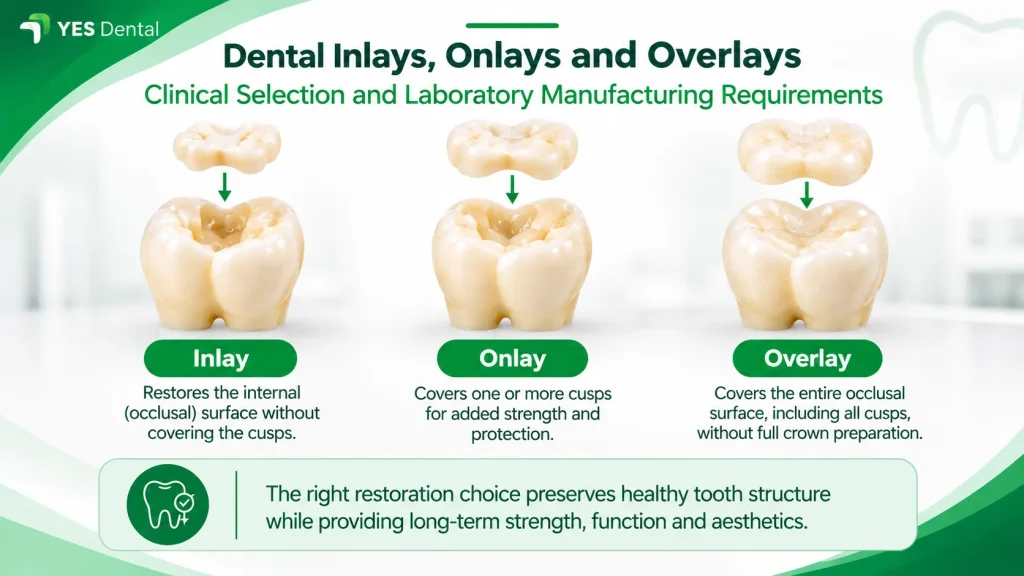
Inlays, onlays and overlays are indirect dental restorations manufactured outside the mouth. Their primary difference lies in the amount of tooth structure they cover and the extent of cuspal protection they provide.
| Restoration type | Coverage | Clinical consideration |
| Inlay | Intracoronal coverage without cusp replacement | Suitable when remaining cusps have adequate structural integrity. |
| Onlay | Covers one or more cusps | Considered when selected cusps require reinforcement or replacement. |
| Overlay | Covers the entire occlusal surface, including all cusps | Considered when extensive occlusal coverage is required without conventional circumferential crown preparation. |
Unlike full-coverage crowns, indirect partial coverage restorations aim to retain suitable remaining tooth structure.
The final selection depends on the clinical assessment rather than the size of the cavity alone.
Our guide to different types of dental restorations provides a broader overview of restorative treatment options.
Clinical Factors That Influence Restoration Selection
Choosing between an inlay, onlay and overlay requires an assessment of the remaining tooth structure, functional demands and available restorative space.
1. Remaining Tooth Structure
An inlay may be appropriate when the remaining cusps are structurally sound. However, weakened or undermined cusps may require coverage through an onlay or another suitable restoration.
When most of the occlusal surface requires reconstruction, an overlay may be considered.
The presence of cracks, previous restorations and weakened marginal ridges should also influence the clinical decision.
2. Occlusal Loading
Posterior restorations are exposed to functional forces that vary with tooth position, occlusal relationships and parafunctional activity.
Relevant information about heavy occlusal contacts or bruxism should be communicated to the laboratory. This allows technicians to assess whether the proposed restoration provides adequate material thickness and appropriate contact distribution.
3. Adhesive Bonding Conditions
Many ceramic partial-coverage restorations rely on adhesive bonding for retention.
The availability of suitable bonding surfaces, margin accessibility and the ability to maintain isolation during cementation should be assessed before selecting the restoration.
Where predictable adhesive bonding is difficult to achieve, an alternative restorative approach may be more appropriate.
Dental Inlay and Onlay Preparation Requirements
Preparation geometry directly influences how accurately a laboratory can manufacture an indirect restoration.
A preparation that preserves tooth structure but provides insufficient space for the selected material can create manufacturing difficulties.
Rounded Internal Line Angles
Sharp internal angles can create localised stress concentrations within ceramic restorations. They may also be difficult to reproduce using milling instruments.
Rounded transitions between cavity walls and floors support more compatible internal restoration geometry.
Clear Path of Insertion
Uncontrolled undercuts can prevent complete seating of a rigid indirect restoration.
The preparation should provide a suitable insertion path without unnecessarily removing healthy tooth structure. Any required correction or blockout should be coordinated with the prescribing dentist.
Clearly Defined Preparation Margins
The laboratory must be able to identify the entire preparation boundary accurately.
Incomplete scans, indistinct margins and inaccessible proximal areas can interfere with margin identification and restoration adaptation.
Adequate Restorative Clearance
The preparation must provide sufficient space for the prescribed restorative material, particularly in areas exposed to functional loading.
There is no universal preparation depth suitable for all ceramic inlays, onlays and overlays. Required dimensions depend on the specific material, restoration configuration and manufacturer’s instructions.
Material Selection for Indirect Partial-Coverage Restorations
Material selection should be coordinated before tooth preparation whenever possible. Different materials require different preparation dimensions, manufacturing procedures and cementation protocols.
| Material | Potential application | Laboratory consideration |
| Lithium disilicate | Adhesively bonded ceramic inlays, onlays and selected overlays | Material thickness, milling or pressing requirements and surface finishing. |
| Resin-based CAD/CAM materials | Selected indirect partial-coverage restorations | Product indications, milling parameters and bonding requirements. |
| Zirconia | Selected cases where appropriate product indications support partial coverage | Minimum dimensions and material-specific surface treatment. |
| Cast metal alloys | Selected functional posterior restorations | Preparation geometry, casting requirements and retention design. |
A material’s strength alone does not determine its suitability. Bonding compatibility, restoration geometry and available restorative space are equally important.
For a broader understanding of restorative material properties, refer to our dental crown materials comparison.
Laboratory Manufacturing Workflow for Inlays and Onlays
Dental inlay and onlay fabrication requires particular attention to internal adaptation, marginal integrity and thin restoration areas.
1. Preparation and Prescription Evaluation
Before production begins, the laboratory evaluates the submitted impression or digital scan.
The technician checks whether the preparation boundaries, proximal surfaces and relevant anatomical features are sufficiently visible. The prescribed restoration type and material are also reviewed for manufacturing compatibility.
Unclear information should be resolved with the clinic before proceeding.
2. Restoration Design and Internal Adaptation
During CAD design, technicians establish the internal restoration surface, marginal outline and external anatomy.
Unlike a full-coverage crown, an inlay must adapt to an internal cavity without binding against its walls. An onlay must also maintain appropriate transitions between intracoronal areas and covered cusps.
Internal spacing and restoration thickness should follow validated material and production requirements.
3. Material Processing
CAD/CAM inlays and onlays may be milled from compatible restorative blocks. Other ceramic restorations may be produced using pressing techniques.
The manufacturing process must correspond to the selected material and approved design.
Some ceramic materials require additional crystallisation, firing or finishing procedures according to their specific processing instructions.
4. Finishing and Surface Characterisation
After fabrication, the restoration undergoes appropriate finishing.
Technicians refine the external anatomy, remove production-related irregularities and complete the required polishing or characterisation procedures.
Thin margins and functional contact areas require particular care to avoid compromising restoration geometry.
5. Final Laboratory Quality Control
The final restoration should be inspected before dispatch.
Important checks include:
- Marginal integrity and visible defects.
- Internal adaptation on a suitable working model, where available.
- Proximal contact relationships.
- Occlusal anatomy and available clearance.
- Material-specific thickness requirements.
- Surface finish, shade and characterisation.
Clinical seating, bonding and final occlusal evaluation remain the responsibility of the treating dentist.
Common Manufacturing Problems and How to Prevent Them
Several avoidable manufacturing problems originate from incomplete clinical information or preparation geometry.
| Problem | Possible cause | Preventive action |
| Restoration does not seat completely | Internal interference or undercuts | Review preparation geometry and insertion path before manufacturing. |
| Thin or chipped ceramic margins | Insufficient material support or unsuitable finishing | Confirm margin geometry and material requirements. |
| Excessive chairside adjustment | Inaccurate bite records or contact relationships | Submit reliable opposing arch scans and occlusal records. |
| Internal adaptation problems | Sharp preparation angles or milling limitations | Establish compatible preparation geometry and internal spacing. |
| Shade mismatch | Incomplete shade or substrate information | Provide shade references and relevant clinical photographs. |
Identifying these issues before production can help reduce unnecessary revisions and improve communication between the clinic and laboratory.
What Should Dentists Send for Inlay and Onlay Fabrication?
A complete laboratory prescription should clearly communicate the intended partial-coverage restoration.
Include the following information when submitting a case:
- Tooth number and prescribed restoration type.
- Complete preparation scan or accurate physical impression.
- Opposing arch records and bite registration.
- Required restorative material and shade.
- Relevant substrate shade and clinical photographs.
- Intended cusp coverage and specific margin instructions.
- Relevant occlusal or functional considerations.
For general submission requirements, refer to our dental laboratory case submission guide.
Providing restoration-specific instructions allows technicians to understand the clinical objectives rather than relying entirely on the preparation geometry.
How Can YES Dental Help With Inlay and Onlay Manufacturing?
At YES Dental, we understand that successful indirect restorations require close coordination between the dentist and dental laboratory. From preparation assessment to final restoration fabrication, our team helps dental professionals address case-specific manufacturing requirements.
Our crown and bridge manufacturing services support dentists, dental clinics and dental laboratories with customised restorative solutions.
Here’s how YES Dental can support your inlay and onlay cases:
- Case-specific manufacturing: Restorations developed according to clinical prescriptions and individual case requirements.
- Digital CAD/CAM workflow: Digital design and compatible manufacturing processes to support restoration accuracy.
- Material selection support: Coordination with dental professionals regarding suitable restorative materials and manufacturing requirements.
- Marginal and internal adaptation: Attention to preparation boundaries, internal geometry and restoration fit.
- Anatomical and aesthetic requirements: Consideration of occlusal anatomy, proximal contacts, shade and surface characterisation.
- Laboratory quality control: Evaluation of restoration geometry, surface finish and manufacturing quality before dispatch.
Whether you are managing a single posterior restoration or multiple restorative cases, YES Dental can support your laboratory requirements while you focus on clinical treatment.
Our objective is to help dental professionals minimise avoidable manufacturing complications and achieve restorations that meet their clinical prescriptions.
Conclusion
Successful dental inlay and onlay fabrication begins with appropriate clinical selection and preparation planning.
Preserving healthy tooth structure must be balanced against material thickness, adhesive bonding conditions and manufacturing requirements. Clear communication between the dentist and laboratory is essential throughout this process.
A coordinated restorative workflow helps ensure that the final restoration follows the prescribed design and clinical objectives.
Send Your Next Inlay or Onlay Case to YES Dental
Need a dental laboratory for indirect partial-coverage restorations?
Contact YES Dental to discuss your inlay and onlay manufacturing requirements, preferred materials and clinical case specifications.
Frequently Asked Questions
1. What is the difference between an inlay, onlay and overlay in restorative dentistry?
An inlay restores intracoronal tooth structure without covering cusps. An onlay covers one or more cusps, while an overlay generally covers the complete occlusal surface, including all cusps.
2. Which material is suitable for ceramic inlay and onlay restorations?
Lithium disilicate is commonly considered for bonded ceramic partial-coverage restorations. Material selection depends on preparation geometry, available clearance, functional requirements and product indications.
3. What are the preparation requirements for CAD/CAM inlays and onlays?
The preparation should provide clearly defined margins, rounded internal angles, a suitable insertion path and adequate space for the selected restorative material. Specific dimensions must follow the manufacturer’s instructions.
4. How are CAD/CAM inlays and onlays manufactured?
Digital models are used to design the restoration, assess internal adaptation and establish external anatomy. The approved restoration is milled from a compatible material and undergoes the required processing, finishing and inspection procedures.
5. What information does a dental laboratory need to fabricate an inlay or onlay?
The laboratory typically requires a preparation scan or impression, opposing arch records, bite registration, tooth number, prescribed restoration type, material, shade and relevant clinical instructions.