
Implant restorations are custom-made dental prostheses attached to dental implants to replace missing teeth or restore function and appearance. Common types include single implant crowns, implant-supported bridges, and full-arch restorations. Depending on the case, materials such as zirconia, PFM, metal, and provisional materials may be used according to clinical and restorative requirements.
What Is an Implant Restoration?
An implant restoration is the prosthetic part of an implant treatment that replaces the visible portion of a missing tooth or teeth.
A dental implant acts as a foundation, while the restoration provides the functional and visible replacement. The restoration is connected to the implant through an abutment or another compatible implant component.
Implant restorations can be used to replace:
- A single missing tooth
- Multiple missing teeth
- Several teeth in a row
- An entire dental arch
The appropriate restoration depends on factors such as implant position, available space, functional requirements, aesthetics, and the overall treatment plan.
Types of Implant Restorations
1. Single Implant Crown
A single implant crown replaces one missing tooth using a dental implant for support.
Unlike a conventional dental bridge, an implant crown does not require the adjacent natural teeth to act as supports. Depending on the case, zirconia, PFM, or other suitable materials may be considered.
Single implant crowns are commonly used for both anterior and posterior tooth replacement, with material selection depending on functional and aesthetic requirements.
2. Implant-Supported Bridge
An implant-supported bridge can replace multiple missing teeth using dental implants as support.
Instead of placing an individual implant for every missing tooth, a bridge can span the space between supporting implants when clinically appropriate.
Implant-supported bridges can be manufactured using materials such as zirconia or metal-ceramic, depending on the restoration design and treatment requirements.
3. Screw-Retained Implant Restoration
A screw-retained implant restoration is secured using a prosthetic screw connected to the implant or implant component.
One major characteristic of this approach is retrievability. A dental professional can generally remove the restoration when maintenance, repair, or other treatment is required.
However, factors such as implant angulation, screw-access position, aesthetics, occlusion, and component selection should be considered when choosing this restoration type.
4. Cement-Retained Implant Restoration
A cement-retained implant restoration is cemented onto an abutment connected to the dental implant.
This approach may be considered in cases where the position of the implant makes a screw-access channel undesirable from an aesthetic or restorative perspective.
Careful cement management is important because excess cement around implant restorations can create biological concerns.
The choice between screw-retained and cement-retained restorations should therefore be based on the individual case and professional treatment plan.
5. Full-Arch Implant Restoration
Full-arch implant restorations are designed to replace most or all teeth in an arch using multiple implants for support.
These restorations can involve more complex restorative requirements than a single implant crown. Factors such as implant position, occlusion, prosthetic space, material selection, aesthetics, and overall restoration design become particularly important.
Full-arch restorations are also closely related to All-on-X treatment concepts, which use strategically positioned implants to support a full-arch prosthesis.
Materials Used for Implant Restorations
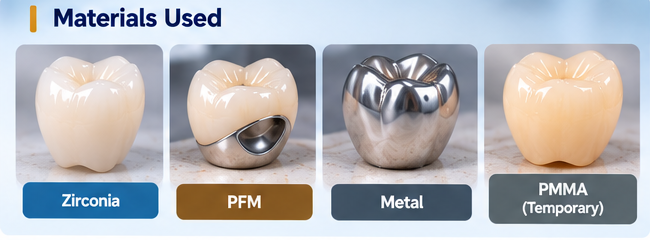
Different materials can be used for implant restorations depending on the type of prosthesis and case requirements.
Zirconia
Zirconia is a ceramic material widely used for implant-supported crowns and other restorative applications.
It is metal-free and offers a combination of strength and optical properties. Modern zirconia materials are available with different balances of strength and translucency.
For suitable cases, zirconia can be used for implant crowns and other fixed restorations where aesthetics and material performance are important.
You can learn more in our article Zirconia Crowns: Benefits, Types, Uses & What to Know.
PFM
Porcelain-fused-to-metal (PFM) restorations combine a metal framework with an outer porcelain layer.
PFM has been used extensively in restorative dentistry and can also be used for certain implant-supported restorations.
The choice between PFM and zirconia depends on factors such as restoration location, aesthetics, functional requirements, available space, and material properties.
Provisional Materials
Materials such as PMMA may be used for provisional or temporary implant restorations during different stages of treatment.
Provisional restorations serve a different purpose from definitive restorations and may be used while the final restoration is being prepared.
Screw-Retained vs Cement-Retained Implant Restorations
Both retention methods can have appropriate applications.
| Feature | Screw-Retained | Cement-Retained |
|---|---|---|
| Retention | Prosthetic screw | Cement |
| Retrievability | Generally easier | Generally more difficult |
| Screw access | Required | Not visible through crown |
| Cement management | Not required | Important |
| Aesthetic considerations | Screw position may matter | May offer an aesthetic advantage in some cases |
| Case selection | Depends on clinical requirements | Depends on clinical requirements |
Neither method is automatically better for every patient. Implant position, aesthetics, retrievability, occlusion, available space, and restoration design should all be considered.
Where Are Implant Restorations Used?
Implant restorations can be used for a wide range of restorative situations, including:
- Single missing teeth
- Multiple missing teeth
- Anterior tooth replacement
- Posterior tooth replacement
- Implant-supported bridges
- Full-arch restorations
- Implant-supported prostheses
The final restoration should be selected according to the patient’s clinical condition and the treatment plan established by the dental professional.
How to Choose the Right Implant Restoration
Several factors can influence restoration selection.
Implant position: The position and angulation of the implant can affect restoration design and retention.
Functional requirements: Posterior and full-arch restorations may experience significant functional forces, making material and design important considerations.
Aesthetic requirements: For visible teeth, shade, translucency, surface characteristics, and overall appearance may influence material selection.
Available space: Vertical restorative space and occlusal clearance can affect the type of restoration and material that can be used.
Retention method: Screw-retained and cement-retained restorations have different characteristics and should be selected according to the case.
Material: Zirconia, PFM, and provisional materials have different properties and applications.
How Are Implant Restorations Manufactured?
Modern implant restoration production can involve a combination of digital planning, manufacturing, finishing, and quality-control processes.
A simplified production sequence is:
Case Information → Restoration Planning → Manufacturing → Finishing → Quality Control
Depending on the restoration, manufacturing may involve milling, sintering, ceramic processing, finishing, characterization, and final inspection.
Quality control is particularly important for implant restorations because the final prosthesis must meet the required anatomical, functional, aesthetic, and component-related specifications.
Final checks may include:
- Anatomy
- Margins
- Contacts
- Occlusion
- Surface finish
- Shade and characterization
- Component compatibility
- Overall restoration quality
How YES Dental Supports Implant Restoration Requirements
or dental professionals and laboratories, consistent restoration quality and reliable product supply are important when managing implant restoration cases.
YES Dental provides dental restoration solutions for different restorative requirements, including implant-related restoration products.
Depending on the case, requirements can vary by restoration type, material, implant system, and clinical specifications. YES Dental focuses on producing restoration products according to case requirements while maintaining structured manufacturing and quality-control processes.
You can explore YES Dental’s dental products to learn more about available restoration solutions.
Conclusion
Implant restorations are an important part of modern restorative dentistry and can include single implant crowns, implant-supported bridges, screw-retained restorations, cement-retained restorations, and full-arch prostheses.
The appropriate restoration depends on factors such as implant position, functional requirements, aesthetics, available space, retention method, material selection, and the overall treatment plan.
Zirconia, PFM, and provisional materials can each have suitable applications depending on the type of restoration.
For dental professionals and laboratories looking for restoration products, YES Dental provides solutions designed around different dental restoration requirements and case specifications.
Frequently Asked Questions
1. What is an implant restoration?
An implant restoration is a prosthetic dental restoration attached to a dental implant to replace a missing tooth or multiple teeth. Examples include implant crowns, implant-supported bridges, and full-arch restorations.
2. What are the main types of implant restorations?
The main types include single implant crowns, implant-supported bridges, screw-retained restorations, cement-retained restorations, and full-arch implant restorations.
3. Is zirconia suitable for implant restorations?
Zirconia can be used for various implant-supported restorations, including implant crowns. Its suitability depends on the restoration design, material characteristics, clinical requirements, and treatment plan.
4. What is the difference between screw-retained and cement-retained implant restorations?
Screw-retained restorations are secured using a prosthetic screw, while cement-retained restorations are cemented onto an implant abutment. The appropriate option depends on factors such as implant position, aesthetics, retrievability, and restoration requirements.
5. Does YES Dental provide implant restoration products?
YES Dental provides dental restoration solutions for different restorative requirements, including implant-related restoration products. Dental professionals and laboratories can explore the YES Dental Products page for available solutions.